
|
You entered: radio emission
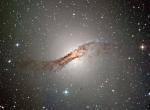 Dusty Galaxy Centaurus A
6.08.2003
Why is peculiar galaxy Centaurus A so dusty? Dramatic dust lanes that run across the galaxy's center mark Cen A. These dust lanes are so thick they almost completely obscure the galaxy's center in visible light.
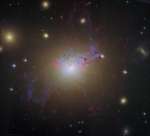 Hubble Remix: Active Galaxy NGC 1275
4.06.2010
Active galaxy NGC 1275 is the central, dominant member of the large and relatively nearby Perseus Cluster of Galaxies. Wild-looking at visible wavelengths, the active galaxy is also a prodigious source of x-rays and radio emission.
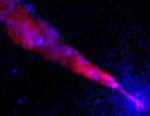 The Energetic Jet from Centaurus A
1.05.2003
The center of well-studied active galaxy Centaurus A is hidden from the view of optical telescopes by a cosmic jumble of stars, gas, and dust. But both radio and x-ray telescopes can trace the remarkable jet of high-energy particles streaming from the galaxy's core.
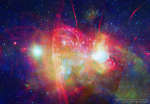 The Galactic Center from Radio to X ray
31.03.2020
In how many ways does the center of our Galaxy glow? This enigmatic region, about 26,000 light years away toward the constellation of the Archer (Sagittarius), glows in every type of light that we can see.
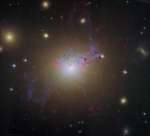 Hubble Remix: Active Galaxy NGC 1275
6.10.2013
Active galaxy NGC 1275 is the central, dominant member of the large and relatively nearby Perseus Cluster of Galaxies. Wild-looking at visible wavelengths, the active galaxy is also a prodigious source of x-rays and radio emission.
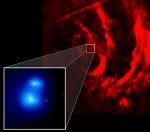 Around The Arches Cluster
14.06.2001
The most compact cluster of stars known in our galaxy, the Arches cluster, boasts 100 or so massive, young stars contained within a diameter of one light-year. Seen toward the constellation Sagittarius, the Arches...
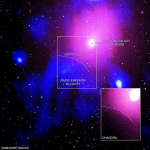 An Extreme Black Hole Outburst
11.03.2020
Astronomers believe they have now found the most powerful example of a black hole outburst yet seen in our Universe. The composite, false-color featured image is of a cluster of galaxies in the constellation of Ophiuchus, the serpent-bearer.
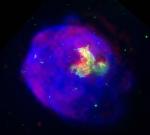 Structure in N63A
1.01.2004
Shells and arcs abound in this false-color, multiwavelength view of supernova remnant N63A, the debris of a massive stellar explosion. The x-ray emission (blue), is from gas heated to 10 million degrees C as knots of fast moving material from the cosmic blast sweep up surrounding interstellar matter.
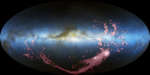 The Magellanic Stream
25.01.2010
Spanning the sky toward the majestic Clouds of Magellan is an unusual stream of gas: the Magellanic Stream. The origin of this gas remains unknown but likely hold a clue to origin and fate of our Milky Way's most famous satellite galaxies: the LMC and the SMC.
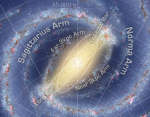 The Far 3kpc Arm
11.07.2008
A major discovery was lurking in the data. By accident, while preparing a talk on the Galaxy's spiral arms for a meeting of the American Astronomical Society, Tom Dame (Harvard-Smithsonian CfA) found it - a new spiral arm in the Milky Way.
|
January February March April May June July August |
||||||||||||||||||||||||||||||||||||||||||||||||||||||||