
|
You entered: magnitude
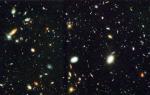 The Hubble Deep Field
1.09.2002
Galaxies like colorful pieces of candy fill the Hubble Deep Field - one of humanity's most distant optical views of the Universe. The dimmest, some as faint as 30th magnitude (about four billion times...
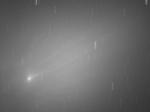 The Inner Coma of Comet Holmes
13.11.2007
What's happening to Comet Holmes? The rare comet remains visible to the unaided eyes of northern observers as an unusual small puff ball in the constellation of Perseus. A high resolution set of images of the comet's inner coma, taken last week and shown above, reveals significant detail.
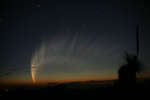 The Magnificent Tail of Comet McNaught
6.12.2009
Comet McNaught, the Great Comet of 2007, was the brightest comet of the last 40 years. Its spectacular tail spread across the sky and was breathtaking to behold from dark locations for many Southern Hemisphere observers.
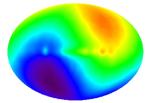 CMBR Dipole: Speeding Through the Universe
8.05.2005
Our Earth is not at rest. The Earth moves around the Sun. The Sun orbits the center of the Milky Way Galaxy. The Milky Way Galaxy orbits in the Local Group of Galaxies. The Local Group falls toward the Virgo Cluster of Galaxies.
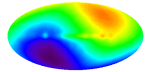 COBE Dipole: Speeding Through the Universe
8.03.1997
Our Earth is not at rest. The Earth moves around the Sun. The Sun orbits the center of the Milky Way Galaxy. The Milky Way Galaxy orbits in the Local Group. The Local Group falls toward the Virgo Cluster of Galaxies.
 Where is Upsilon Andromedae
22.04.1999
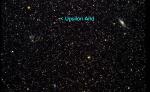
Astronomers recently announced the detection of three large planets orbiting the star Upsilon Andromedae - the first planetary system known to orbit a normal star other than our Sun. These planets were not directly photographed but found through a Doppler technique developed to use large telescopes to search nearby stars for wobbling planetary signatures.
 COBE Dipole: Speeding Through the Universe
5.02.1996
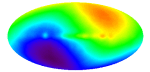
Our Earth is not at rest. The Earth moves around the Sun. The Sun orbits the center of the Milky Way Galaxy. The Milky Way Galaxy orbits in the Local Group. The Local Group falls toward the Virgo Cluster of Galaxies.
 Announcing Comet Catalina
18.08.2015
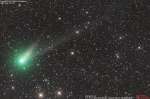
Will Comet Catalina become visible to the unaided eye? Given the unpredictability of comets, no one can say for sure, but it seems like a good bet. The comet was discovered in 2013 by observations of the Catalina Sky Survey.
 Comet NEAT Approaches the Sun
10.02.2003
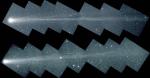
A comet may likely become visible to the unaided eye over the next few days above the horizon where the Sun has just set. Comet NEAT (C/ 2002 V1), discovered last November, has brightened dramatically as it approached the Sun.
 The Magnificent Tail of Comet McNaught
22.01.2007
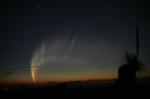
Comet McNaught, the Great Comet of 2007, has grown a long and filamentary tail. The spectacular tail spreads across the sky and is visible to Southern Hemisphere observers just after sunset. The head of the comet remains quite bright and easily visible to even city observers without any optical aide.
|
January February March April May June July August |
||||||||||||||||||||||||||||||||||||||||||||||||||||||||