
|
You entered: ionization region
 The Nebulous Realm of WR 134
31.05.2024
Made with narrowband filters, this cosmic snapshot covers a field of view over twice as wide as the full Moon within the boundaries of the constellation Cygnus. It highlights the bright edge of a ring-like nebula traced by the glow of ionized hydrogen and oxygen gas.
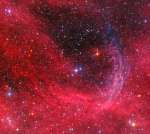 WR 134 Ring Nebula
21.06.2012
Made with narrow and broad band filters, this colorful cosmic snap shot covers a field of view about the size of the full Moon within the boundaries of the constellation Cygnus. It highlights the bright edge of a ring-like nebula traced by the glow of ionized hydrogen and oxygen gas.
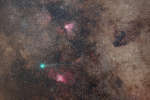 SWAN, Swan, Eagle
23.10.2025
Comet C/2025 R2 (SWAN) sports a greenish coma and fainter tail, seen against congeries of stars and dusty interstellar clouds in this 7 degree wide telescopic field of view from October 17. On that...
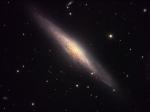 NGC 2683: Spiral Edge On
27.11.2004
This gorgeous island universe, cataloged as NGC 2683, lies a mere 16 million light-years distant in the northern constellation Lynx. A spiral galaxy comparable to our own Milky Way, NGC 2683 is seen nearly edge-on in this cosmic vista, with more distant galaxies scattered in the background.
 WR 134 Ring Nebula
18.05.2023
Made with narrowband filters, this cosmic snapshot covers a field of view about the size of the full Moon within the boundaries of the constellation Cygnus. It highlights the bright edge of a ring-like nebula traced by the glow of ionized sulfur, hydrogen, and oxygen gas.
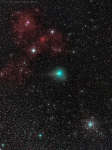 A Charioteer s Comet
1.03.2019
Still racing across planet Earth's night skies, Comet Iwamoto (C/2018 Y1) shares this pretty telescopic field of view with stars and nebulae of northern constellation Auriga, the Charioteer. Captured on February 27, Iwamoto's greenish coma and faint tail appear between a complex of reddish emission nebulae and open star cluster M36 (bottom right).
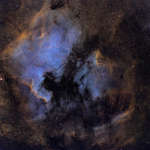 North America and the Pelican
18.12.2010
Here lie familiar shapes in unfamiliar locations. On the left is an emission nebula cataloged as NGC 7000, famous partly because it resembles our fair planet's continent of North America. The emission region to the right of the North America Nebula is IC 5070, also known for its suggestive outlines as the Pelican Nebula.
 APOD: 2025 July 5 Б Ou4: The Giant Squid Nebula
5.07.2025
Difficult to capture, this mysterious, squid-shaped interstellar cloud spans nearly three full moons in planet Earth's sky. Discovered in 2011 by French astro-imager Nicolas Outters, the Squid Nebula's bipolar shape is distinguished here by the telltale blue emission from doubly ionized oxygen atoms.
 APOD: 2024 June 17 Б Ou4: The Giant Squid Nebula
17.06.2024
Squids on Earth aren't this big. This mysterious squid-like cosmic cloud spans nearly three full moons on planet Earth's sky. Discovered in 2011 by French astro-imager Nicolas Outters, the Squid Nebula's bipolar shape is distinguished here by the telltale blue emission from doubly ionized oxygen atoms.
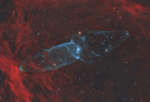 Ou4: The Giant Squid Nebula
12.10.2022
A mysterious squid-like cosmic cloud, this nebula is very faint, but also very large in planet Earth's sky. In the image, composed with 30 hours of narrowband image data, it spans nearly three full moons toward the royal constellation Cepheus.
|
January February |
|||||||||||||||||||||||||||||||||||||||||||||||||