
|
You entered: interstellar medium
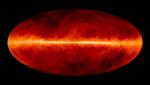 A Sky Full Of Hydrogen
13.01.2001
Interstellar space is filled with extremely tenuous clouds of gas which are mostly Hydrogen. The neutral hydrogen atom (HI in astronomer's shorthand) consists of 1 proton and 1 electron. The proton and electron spin like tops but can have only two orientations; spin axes parallel or anti-parallel.
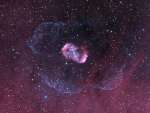 A Halo for NGC 6164
27.10.2012
Beautiful emission nebula NGC 6164 was created by a rare, hot, luminous O-type star, some 40 times as massive as the Sun. Seen at the center of the cosmic cloud, the star is a mere 3 to 4 million years old.
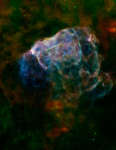 Supernova Remnant Puppis A
12.09.2014
Driven by the explosion of a massive star, supernova remnant Puppis A is blasting into the surrounding interstellar medium about 7,000 light-years away. At that distance, this remarkable false-color exploration of its complex expansion is about 180 light-years wide.
 A Halo for NGC 6164
7.05.2009
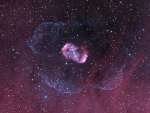
Beautiful emission nebula NGC 6164 was created by a rare, hot, luminous O-type star, some 40 times as massive as the Sun. Seen at the center of the cosmic cloud, the star is a mere 3 to 4 million years old.
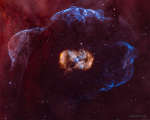 NGC 6164: Dragons Egg Nebula and Halo
26.12.2022
The star at the center created everything. Known as the Dragon's Egg, this star -- a rare, hot, luminous O-type star some 40 times as massive as the Sun -- created not only the complex nebula (NGC 6164) that immediately surrounds it, but also the encompassing blue halo.
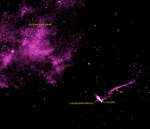 The Long Jet of the Lighthouse Nebula
21.02.2014
The Lighthouse nebula was formed by the wind of a pulsar, a rapidly rotating, magnetized neutron star, as it speeds through the interstellar medium at over 1,000 kilometers per second. Some...
 APOD: 2024 February 12 Б HFG1 & Abell 6: Planetary Nebulae
12.02.2024
Planetary nebulae like Heckathorn-Fesen-Gull 1 (HFG1) and Abell 6 in the constellation Cassiopeia are remnants from the last phase of a medium sized star like our Sun. In spite of their shapes, planetary nebulae have nothing in common with actual planets.
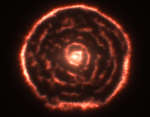 A Spiral Nebula Surrounding Star R Sculptoris
16.10.2012
What's happening around that star? An unusual spiral structure has been discovered around the Milky Way star R Sculptoris, a red giant star located about 1,500 light years away toward the constellation of the Sculptor (Sculptoris).
 Supernova Remnant Cassiopeia A
17.01.2025
Massive stars in our Milky Way Galaxy live spectacular lives. Collapsing from vast cosmic clouds, their nuclear furnaces ignite and create heavy elements in their cores. After only a few million years for the most massive stars, the enriched material is blasted back into interstellar space where star formation can begin anew.
 NGC 6164: A Dragon s Egg
24.04.2025
Beautiful emission nebula NGC 6164 was created by a rare, hot, luminous O-type star, some 40 times as massive as the Sun. Seen at the center of the cosmic cloud, the star is a mere 3 to 4 million years old.
|
January February March April May June July August September |
|||||||||||||||||||||||||||||||||||||||||||||||||