
|
You entered: face on Mars
 Odyssey Over Mars
22.03.2002
Scroll right and journey for 300 kilometers over Terra Sirenum in the cratered highlands of southern Mars. The infrared view, 32 kilometers wide, was recently recorded by the THEMIS camera on board the orbiting Mars Odyssey spacecraft.
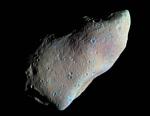 Asteroid Gaspra s Best Face
27.10.2002
Asteroid 951 Gaspra is a huge rock tumbling in space. Gaspra became one of the best-studied spacecraft Galileo flew by. In the above photograph, subtle color variations have been exaggerated to highlight changes in reflectivity, surface structure and composition.
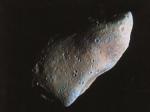 Asteroid Gaspra's Best Face
12.07.1998
Asteroid 951 Gaspra is a huge rock tumbling in space. Gaspra became one of the best-studied asteroids in 1991 when the spacecraft Galileo flew by. In the above photograph, subtle color variations have been exaggerated to highlight changes in reflectivity, surface structure and composition.
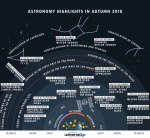 Highlights of the North Autumn Sky
25.09.2018
What can you see in the night sky this season? The featured graphic gives a few highlights for Earth's northern hemisphere. Viewed as a clock face centered at the bottom, early (northern) autumn sky events fan out toward the left, while late autumn events are projected toward the right.
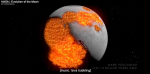 Evolution of the Moon
20.03.2012
What is the history of the Moon? The Moon was likely created from debris expelled when a Mars-sized object violently impacted the Earth about 4.5 billion years ago. Just after gravitationally condensing, as imagined above, the glowing-hot surface of the Moon cooled and cracked.
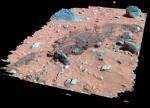 Martian Surface in Perspective
16.01.2004
Spirit moved across Mars yesterday as the rover successfully maneuvered down off its lander, driving its six wheels onto the floor of Gusev crater. As planned, the robotic geologist will now begin a close-up examination of the rocks and soil around the landing site for clues to the processes that formed them.
 Highlights of the Summer Sky
27.06.2018
What can you see in the night sky this summer? The featured graphic gives a few highlights for Earth's northern hemisphere. Viewed as a clock face centered at the bottom, early (northern) summer sky events fan out toward the left, while late summer events are projected toward the right.
|
January February March April May June July August September |
|||||||||||||||||||||||||||||||||||||||||||||||||