
|
You entered: big bang
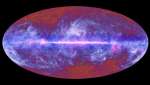 Microwave Milky Way
9.07.2010
Seen from our edge-on perspective, the Milky Way Galaxy sprawls across the middle of this false-color, all sky view. The expansive microwave map is based on 1 year's worth of data from instruments onboard the sky-surveying Planck spacecraft.
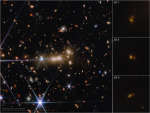 APOD: 2023 January 18 Б MACS0647: Gravitational Lensing of the Early Universe by Webb
18.01.2023
Gravitational lensing by the galaxy cluster MACS0647 -- in which the massive foreground cluster distorts and lenses the light emitted by distant background galaxies along the line of sight Б is on vivid display here in this recent multi-color infrared image from the James Webb Space Telescope (JWST).
 APOD: 2024 July 1 Б Time Spiral
1.07.2024
What's happened since the universe started? The time spiral shown here features a few notable highlights. At the spiral's center is the Big Bang, the place where time, as we know it, began about 13.8 billion years ago.
 Microwave Hotspots: The Oldest Structures Known
29.10.2000
These spots are the oldest, most distant structures known. They are seen on the above two images of the microwave sky, north and south of our galaxy's equator, based on four-year's worth of data from NASA's COsmic Background Explorer (COBE) satellite (1989-1993). The spots represent temperature variations in the early universe.
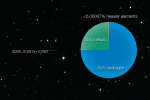 J102815: A Star That Should Not Exist
7.09.2011
Why does this star have so few heavy elements? Stars born in the generation of our Sun have an expected abundance of elements heavier than hydrogen and helium mixed into their atmospheres. Stars born...
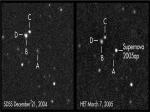 SN 2005ap: The Brightest Supernova Yet Found
16.10.2007
What could cause a bang this big? This supernova explosion was so inherently bright that it could be seen nearby 5 billion light years away (a redshift of 0.28) even with a small telescope.
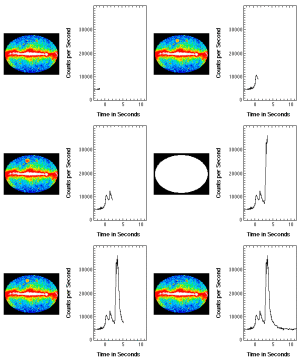 Gamma Ray Bursting
4.11.1999
Using graphics and data from NASA's Compton Gamma Ray Observatory, this animation illustrates one of the most exciting mysteries of modern astrophysics, gamma-ray bursts. Incredibly gamma-ray bursts, sudden flashes of radiation with over 100,000 times the energy of visible light photons, occur several times a day.
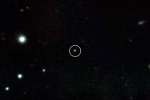 GRB 090423: The Farthest Explosion Yet Measured
29.04.2009
An explosion so powerful it was seen clear across the visible universe was recorded in gamma-radiation last week by NASA's orbiting Swift Observatory. Farther than any known galaxy, quasar, or optical supernova, the gamma-ray burst recorded last week was clocked at redshift 8.2, making it the farthest explosion of any type yet detected.
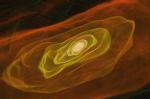 Zooming in on the First Stars
10.06.2003
What became of the first stars? No known stars appear to be composed of truly primordial gas -- all of the stars around us have too many heavy elements. Our own Sun is thought to be a third generation star, with many second-generation stars seen in globular clusters.
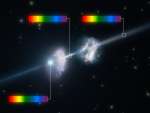 Caught in the Afterglow
24.11.2011
In this artist's illustration, two distant galaxies formed about 2 billion years after the big bang are caught in the afterglow of GRB090323, a gamma-ray burst seen across the Universe. Shining through...
|
January February March April May June July August September |
|||||||||||||||||||||||||||||||||||||||||||||||||