
|
You entered: TRACE
 APOD: 2025 June 21 Б Two Worlds, Two Analemmas
20.06.2025
Sure, that figure-8 shaped curve you get when you mark the position of the Sun in Earth's sky at the same time each day over one year is called an analemma.
 APOD: 2026 July 24 Б RCW 86: Historical Supernova Remnant
23.07.2026
In 185 AD, Chinese astronomers recorded the appearance of a new star in the Nanmen asterism. That part of the sky is identified with part of the southern constellation Centaurus on modern star charts.
 Star Trails in Northern Skies
12.09.1998
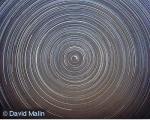
As the Earth spins on its axis, the sky seems to rotate around us. This motion produces the beautiful concentric trails traced by the stars in this time exposure of the night sky.
 Star Trails in Northern Skies
30.11.1996
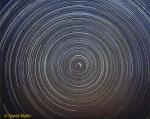
As the Earth spins on its axis, the sky seems to rotate around us. This motion produces the beautiful concentric arcs traced out by the stars in this time exposure of the night sky.
 Star Trails in Southern Skies
25.09.1995
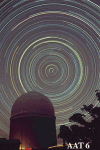
As the Earth spins on its axis, the sky seems to rotate around us. This motion produces the beautiful concentric arcs traced out by the stars in this time exposure of the night sky. In the foreground of the picture is the dome of the Anglo-Australian Telescope in central New South Wales Australia.
 A Sun Pillar
12.03.2001
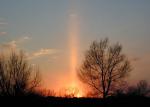
Have you ever seen a sun pillar? When the air is cold and the Sun is rising or setting, falling ice crystals can reflect sunlight and create an unusual column of light. Ice sometimes forms flat, stop-sign shaped crystals as it falls from high-level clouds.
 The Pipe Dark Nebula
26.05.2002
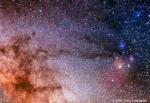
The dark nebula predominant at the lower left of the above photograph is known as the Pipe Nebula. The dark clouds, suggestively shaped like smoke rising from a pipe, are caused by absorption of background starlight by dust.
 The Pipe Dark Nebula
28.05.1996
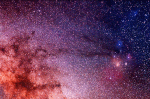
The dark nebula predominant at the lower left of the above photograph is known as the Pipe Nebula. The dark clouds, suggestively shaped like smoke rising from a pipe, are caused by absorption of background starlight by dust.
 The Pipe Dark Nebula
21.06.1997
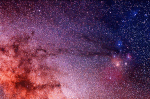
The dark nebula predominant at the lower left of the above photograph is known as the Pipe Nebula. The dark clouds, suggestively shaped like smoke rising from a pipe, are caused by absorption of background starlight by dust.
 The Pipe Dark Nebula
4.03.2000
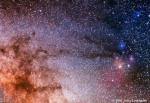
The dark nebula predominant at the lower left of the above photograph is known as the Pipe Nebula. The dark clouds, suggestively shaped like smoke rising from a pipe, are caused by absorption of background starlight by dust.
|
January February March April May June July August September |
|||||||||||||||||||||||||||||||||||||||||||||||||