
|
You entered: M 2
 A Flight Through the Universe
13.08.2012
What would it be like to fly through the universe? Possibly the best simulated video of this yet has been composed from recently-released galaxy data from the Sloan Digital Sky Survey. Every spot in the above video is a galaxy containing billions of stars.
 MACS 1206: A Galaxy Cluster Gravitational Len
17.10.2011
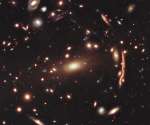
It is difficult to hide a galaxy behind a cluster of galaxies. The closer cluster's gravity will act like a huge lens, pulling images of the distant galaxy around the sides and greatly distorting them.
 Coronal Inflow
29.11.2001
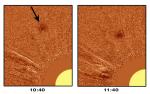
The active Sun has thrown a lot our way lately, including storms of particles streaming outward in the solar wind and clouds of plasma which triggered awesome auroral displays. Still, a growing body...
 The X Ray Sky from eROSITA
23.06.2020
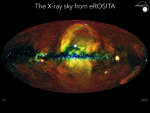
What if you could see X-rays? The night sky would seem a strange and unfamiliar place. X-rays are about 1,000 times more energetic than visible light photons and are produced by violent explosions and high temperature astronomical environments.
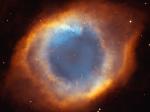 NGC 7293: The Helix Nebula
10.05.2003
Will our Sun look like this one day? The Helix Nebula is the closest example of a planetary nebula created at the end of the life of a Sun-like star. The outer gasses of the star expelled into space appear from our vantage point as if we are looking down a helix.
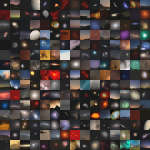 All of These Space Images are Fake Except One
9.11.2021
Why would you want to fake a universe? For one reason -- to better understand our real universe. Many astronomical projects seeking to learn properties of our universe now start with a robotic telescope taking sequential images of the night sky.
 APOD: 2025 June 9 Б Between Scylla and Charybdis: A Double Cosmic Discovery
9.06.2025
Can you identify this celestial object? Likely not Б because this is a discovery image. Massive stars forge heavy elements in their cores and, after a few million years, end their lives in powerful supernova explosions. These remnants cool relatively quickly and fade, making them difficult to detect.
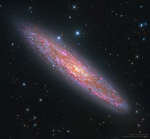 NGC 253: The Silver Coin Galaxy
14.04.2020
NGC 253 is one of the brightest spiral galaxies visible, but also one of the dustiest. Dubbed the Silver Coin for its appearance in smalltelescopes, it is more formally known as the Sculptor Galaxy for its location within the boundaries of the southern constellation Sculptor.
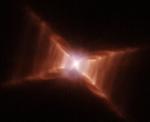 Rungs of the Red Rectangle
13.05.2004
A distinctive X-shape and ladder-like rungs appear in this Hubble Space Telescope image of the intriguing Red Rectangle Nebula. The dusty cosmic cloud was originally identified as a strong source of infrared radiation and is now believed to contain icy dust grains and hydrocarbon molecules formed in the cool outflow from an aging central star.
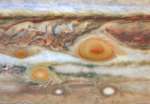 Jupiter s Three Red Spots
23.05.2008
For about 300 years Jupiter's banded atmosphere has shown a remarkable feature to telescopic viewers, a large swirling storm system known as The Great Red Spot. In 2006, another red storm system appeared, actually seen to form as smaller whitish oval-shaped storms merged and then developed the curious reddish hue.
|
January February March April May June July August September |
|||||||||||||||||||||||||||||||||||||||||||||||||