
|
You entered: EGGs
 APOD: 2024 October 22 Б M16: Pillars of Star Creation
22.10.2024
These dark pillars may look destructive, but they are creating stars. This pillar-capturing picture of the Eagle Nebula combines visible light exposures taken with the Hubble Space Telescope with infrared images taken with the James Webb Space Telescope to highlight evaporating gaseous globules (EGGs) emerging from pillars of molecular hydrogen gas and dust.
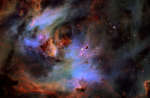 Globules in the Running Chicken Nebula
5.03.2014
The eggs from this chicken may form into stars. The above pictured emission nebula, cataloged as IC 2944, is called the Running Chicken Nebula for the shape of its greater appearance. The image was taken recently from Siding Spring Observatory in Australia and presented in scientifically assigned colors.
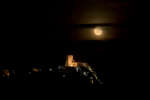 Castle and Full Moon
16.04.2009
Clouds couldn't hide this bright Full Moon as it rose last week over the medieval castle of Tourrette-Levens near Nice, France. Exactly full on April 9 at 1456 UT, it followed the March equinox, making it the first Full Moon of spring in the north and autumn in the southern hemisphere.
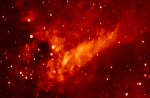 M17: The Majestic Swan Nebula
29.08.1996
What unusual eggs have been laid by this majestic swan? The star forming region above, known as Swan Nebula, is the home of hot red-glowing gas, dark lanes of dust, bright young stars and -- what are those?
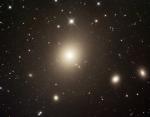 Elliptical Galaxy M87
20.05.2006
In spiral galaxies, majestic winding arms of young stars and interstellar gas and dust rotate in a flat disk around a bulging galactic nucleus. But elliptical galaxies seem to be simpler. Lacking gas and dust to form new stars, their randomly swarming older stars, give them an ellipsoidal (egg-like) shape.
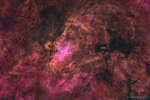 Nest of the Eagle Nebula
4.10.2016
What surrounds the famous Eagle Nebula? The inside of the Eagle Nebula contains eggs -- evaporating gaseous globules -- that typically reside in tremendous pillars of gas and dust and where stars form. This image, though...
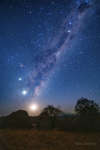 Moon, Four Planets, and Emu
8.02.2019
A luminous Milky Way falls toward the horizon in this deep skyscape, starting at the top of the frame from the stars of the Southern Cross and the dark Coalsack Nebula. Captured...
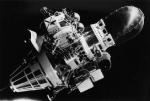 Luna 9: First Soft Lander
7.09.1997
The Luna 9 spacecraft above performed the first soft landing on another planetary body. Following a series of failures, the Soviet probe touched down in the Moon's Oceanus Procellarum region February 3, 1966.
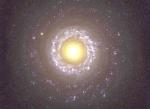 Spiral Galaxy NGC 7742
1.07.2001
This might resemble a fried egg you've had for breakfast, but it's actually much larger. In fact, ringed by blue-tinted star forming regions and faintly visible spiral arms, the yolk-yellow center of this face-on spiral galaxy, NGC 7742, is about 3,000 light-years across.
 Molecular Cloud Barnard 163
1.05.2011
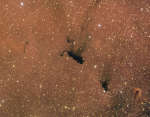
It may look to some like a duck, but it lays stars instead of eggs. In the center of the above image lies Barnard 163, a nebula of molecular gas and dust so thick that visible light can't shine through it.
|
January February March April May June July August September October |
|||||||||||||||||||||||||||||||||||||||||||||||||