
|
You entered: wind
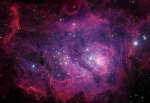 The Wide and Deep Lagoon
9.09.2016
Ridges of glowing interstellar gas and dark dust clouds inhabit the turbulent, cosmic depths of the Lagoon Nebula. Also known as M8, the bright star forming region is about 5,000 light-years distant.
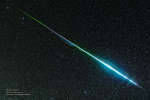 A Rainbow Geminid Meteor
19.12.2018
Meteors can be colorful. While the human eye usually cannot discern many colors, cameras often can. Pictured is a Geminid captured by camera during last week's meteor shower that was not only impressively bright, but colorful.
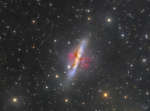 M82: Starburst Galaxy with a Superwind
9.07.2021
M82 is a starburst galaxy with a superwind. In fact, through ensuing supernova explosions and powerful winds from massive stars, the burst of star formation in M82 is driving a prodigious outflow. Evidence for the superwind from the galaxy's central regions is clear in sharp telescopic snapshot.
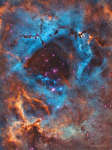 APOD: 2023 February 6 Б In the Heart of the Rosette Nebula
6.02.2023
In the heart of the Rosette Nebula lies a bright cluster of stars that lights up the nebula. The stars of NGC 2244 formed from the surrounding gas only a few million years ago.
 APOD: 2023 December 13 Б Deep Field: The Heart Nebula
13.12.2023
What excites the Heart Nebula? First, the large emission nebula on the left, catalogued as IC 1805, looks somewhat like a human heart. The nebula glows brightly in red light emitted by its most prominent element, hydrogen, but this long-exposure image was also blended with light emitted by silicon (yellow) and oxygen (blue).
 NGC 604: Giant Stellar Nursery
25.04.2024
Located some 3 million light-years away in the arms of nearby spiral galaxy M33, giant stellar nursery NGC 604 is about 1,300 light-years across. That's nearly 100 times the size of the Milky Way's Orion Nebula, the closest large star forming region to planet Earth.
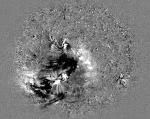 The Sun Puffs
11.04.1997
The Earth has once again endured a burst of particles from the Sun. The latest storm, which began Monday, was one of the best documented solar storms to date. At 10 am (EDT) ground...
 Missoula Crater on Mars
4.05.2004
Scroll right to see the rocks, craters, and hills that were in view for the Spirit rover last week as it continued its trek across Mars. Missoula crater, taking up much of the above frame, appeared from orbit to have ejecta from Bonneville crater inside it.
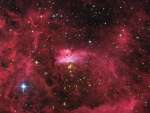 Massive Stars in NGC 6357
9.10.2008
Massive Stars lie within NGC 6357, an expansive emission nebula complex some 8,000 light-years away in the tail of the constellation Scorpius. In fact, positioned just below center in this close-up view...
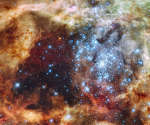 Star Cluster R136 Bursts Out
29.07.2012
In the center of star-forming region 30 Doradus lies a huge cluster of the largest, hottest, most massive stars known. These stars, known collectively as star cluster R136, were captured above in visible light by the newly installed Wide Field Camera peering though the recently refurbished Hubble Space Telescope.
|
January February March April May June |
|||||||||||||||||||||||||||||||||||||||||||||||||