
|
You entered: phase
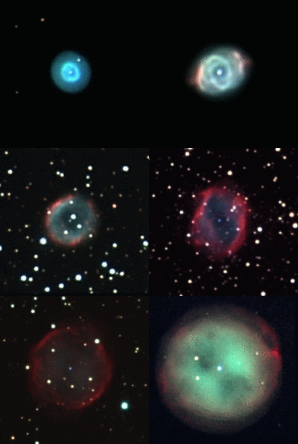 The Planetary Nebula Show
3.10.2001
What do the Owl, the Cat's Eye, the Ghost of Jupiter, and Saturn have in common? They're all planetary nebulae of course(!), glowing gaseous shrouds shed by dying sun-like stars as they run out of nuclear fuel.
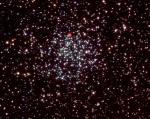 M46 And NGC 2438: Young And Old
5.03.1999
Galactic or open star clusters are relatively young. These swarms of bright stars are born near the plane of the Milky Way, but their numbers steadily dwindle as cluster members are strewn through the Galaxy by gravitational interactions.
 Planetary Nebula NGC 2440
15.02.2007
Planetary nebula NGC 2440 has an intriguing bow-tie shape in this stunning view from space. The nebula is composed of material cast off by a dying sun-like star as it enters its white dwarf phase of evolution.
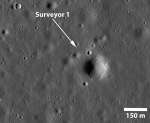 The Shadow of Surveyor 1
4.06.2016
Fifty years ago, Surveyor 1 reached the Moon. Launched on May 30, 1966 and landed on June 2, 1966 with the Moon at full phase it became the first US spacecraft to make a soft landing on another world.
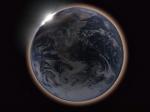 Solar Eclipse from the Moon
2.03.2007
Parts of Saturday's (March 3) lunar eclipse will be widely visible. For example, skywatchers in Europe, Africa, and western Asia will be able to see the entire spectacle of the Moon gliding through Earth's shadow, but in eastern North America the Moon will rise already in its total eclipse phase.
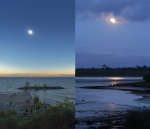 August Moons
21.08.2008
This August was eclipse season. The month's first New Moon and Full Moon were both seen in darkened skies during a solar and lunar eclipse. Blocking the Sun, the left panel...
 Welcome to the International Year of Astronomy
1.01.2009
Astronomers all over planet Earth invite you to experience the night sky as part of the International Year of Astronomy 2009. This year was picked by the International Astronomical Union and the United Nations Educational, Scientific, and Cultural Organization because it occurs 400 years after Galileo turned one of the first telescopes toward the heavens.
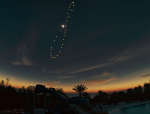 Tutulemma: Solar Eclipse Analemma
22.12.2013
If you went outside at exactly the same time every day and took a picture that included the Sun, how would the Sun's position change? With great planning and effort, such a series of images can be taken. The figure-8 path the Sun follows over the course of a year is called an analemma.
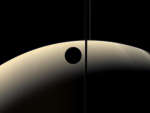 Crescent Rhea Occults Crescent Saturn
20.07.2008
Soft hues, partially lit orbs, a thin trace of the ring, and slight shadows highlight this understated view of the majestic surroundings of the giant planet Saturn. Looking nearly back toward the Sun, the robot Cassini spacecraft now orbiting Saturn captured crescent phases of Saturn and its moon Rhea in color a few years ago.
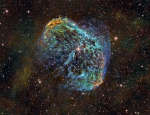 NGC 6888: The Crescent Nebula
16.08.2012
NGC 6888, also known as the Crescent Nebula, is a cosmic bubble about 25 light-years across, blown by winds from its central, bright, massive star. This colorful portrait of the nebula uses narrow band image data combined in the Hubble palatte.
|
January February March April May June July August |
||||||||||||||||||||||||||||||||||||||||||||||||||||||||