
|
You entered: massive stars
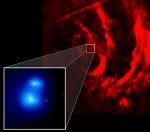 Around The Arches Cluster
14.06.2001
The most compact cluster of stars known in our galaxy, the Arches cluster, boasts 100 or so massive, young stars contained within a diameter of one light-year. Seen toward the constellation Sagittarius, the Arches...
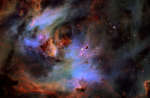 Globules in the Running Chicken Nebula
5.03.2014
The eggs from this chicken may form into stars. The above pictured emission nebula, cataloged as IC 2944, is called the Running Chicken Nebula for the shape of its greater appearance. The image was taken recently from Siding Spring Observatory in Australia and presented in scientifically assigned colors.
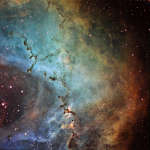 Dust Sculptures in the Rosette Nebula
2.12.2009
What creates the cosmic dust sculptures in the Rosette Nebula? Noted for the common beauty of its overall shape, parts of the Rosette Nebula, also known as NGC 2237, show beauty even when viewed up close.
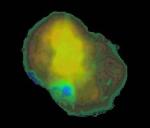 X-Rays From IC 443
2.05.1997
The life-cycles of stars help drive the ecology of our Galaxy, churning, processing, and redistributing matter. Massive stars reach a spectacular evolutionary endpoint - supernovae explosions which blast off their outer layers, violently merging stellar material with the gas and dust of the Milky Way. The supernova remnant IC 443 is typical of the aftermath.
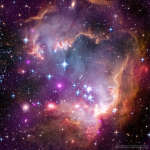 NGC 602 and Beyond
24.03.2018
Near the outskirts of the Small Magellanic Cloud, a satellite galaxy some 200 thousand light-years distant, lies 5 million year young star cluster NGC 602. Surrounded by natal gas and dust...
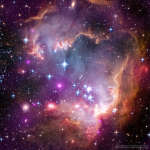 NGC 602 and Beyond
11.01.2020
Near the outskirts of the Small Magellanic Cloud, a satellite galaxy some 200 thousand light-years distant, lies 5 million year young star cluster NGC 602. Surrounded by natal gas and dust...
 The Swirling Core of the Crab Nebula
8.07.2016
At the core of the Crab Nebula lies a city-sized, magnetized neutron star spinning 30 times a second. Known as the Crab Pulsar, it's actually the rightmost of two bright stars, just below a central swirl in this stunning Hubble snapshot of the nebula's core.
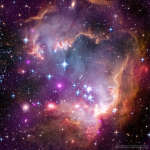 NGC 602 and Beyond
2.04.2017
Near the outskirts of the Small Magellanic Cloud, a satellite galaxy some 200 thousand light-years distant, lies 5 million year young star cluster NGC 602. Surrounded by natal gas and dust...
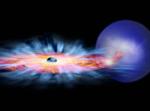 Wind from a Black Hole
1.07.2006
Binary star system GRO J1655-40 consists of a relatively normal star about twice as massive as the Sun co-orbiting with a black hole of about seven solar masses. This striking artist's vision of the exotic binary system helps visualize matter drawn from the normal star by gravity and swirling toward the black hole.
 APOD: 2024 March 5 Б NGC 2170: Angel Nebula Abstract Art
5.03.2024
Is this a painting or a photograph? In this celestial abstract art composed with a cosmic brush, dusty nebula NGC 2170, also known as the Angel Nebula, shines just above the image center. Reflecting...
|
January February March April May |
|||||||||||||||||||||||||||||||||||||||||||||||||