
|
You entered: emission nebula
 The Swirling Core of the Crab Nebula
8.07.2016
At the core of the Crab Nebula lies a city-sized, magnetized neutron star spinning 30 times a second. Known as the Crab Pulsar, it's actually the rightmost of two bright stars, just below a central swirl in this stunning Hubble snapshot of the nebula's core.
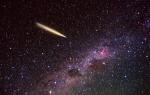 Mystery Over Australia
22.02.2007
Place your cursor on this stunning view of dark skies over western Australia to highlight wonders of the southern Milky Way -- including the famous Southern Cross, the dark Coal Sack Nebula, and bright reddish emission regions surrounding massive star Eta Carinae.
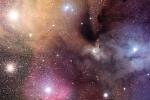 The Colorful Clouds of Rho Ophiuchi
3.09.2007
The many spectacular colors of the Rho Ophiuchi (oh'-fee-yu-kee) clouds highlight the many processes that occur there. The blue regions shine primarily by reflected light. Blue light from the star Rho Ophiuchi and nearby stars reflects more efficiently off this portion of the nebula than red light.
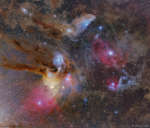 Rho Ophiuchi Wide Field
13.05.2019
The colorful clouds surrounding the star system Rho Ophiuchi compose one of the closest star forming regions. Rho Ophiuchi itself is a binary star system visible in the blue reflection nebula just to the left of the image center.
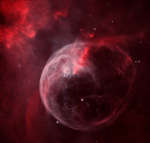 NGC 7635: The Bubble Nebula
19.04.2018
Blown by the wind from a massive star, this interstellar apparition has a surprisingly familiar shape. Cataloged as NGC 7635, it is also known simply as The Bubble Nebula. Although it looks delicate, the 7 light-year diameter bubble offers evidence of violent processes at work.
 APOD: 2024 August 28 Б Tulip Nebula and Black Hole Cygnus X 1
28.08.2024
When can you see a black hole, a tulip, and a swan all at once? At night -- if the timing is right, and if your telescope is pointed in the right direction. The complex and beautiful Tulip Nebula blossoms about 8,000 light-years away toward the constellation of Cygnus the Swan.
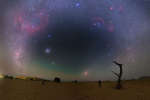 A Gegenschein Lunar Eclipse
14.10.2015
Is there anything interesting to see in the direction opposite the Sun? One night last month, there were quite a few things. First, the red-glowing orb on the lower right of the featured image is the full moon, darkened and reddened because it has entered Earth's shadow.
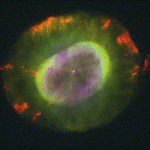 The Blue Snowball Planetary Nebula
21.11.1996
Will the Sun one day look like - a blue snowball? Maybe! The Blue Snowball is a planetary nebula - and in 5 billion years the Sun will throw off its outer layers and go through a planetary nebula phase.
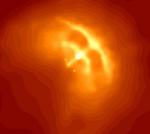 Vela Pulsar: Neutron Star-Ring-Jet
9.06.2000
This stunning image from the orbiting Chandra X-ray Observatory is centered on the Vela pulsar -- the collapsed stellar core within the Vela supernova remnant some 800 light-years distant. The Vela pulsar is a neutron star. More massive than the Sun, it has the
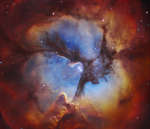 In the Center of the Trifid Nebula
28.01.2013
Clouds of glowing gas mingle with dust lanes in the Trifid Nebula, a star forming region toward the constellation of the Archer (Sagittarius). In the center, the three prominent dust lanes that give the Trifid its name all come together.
|
January February March April May June July August September October |
|||||||||||||||||||||||||||||||||||||||||||||||||