
|
You entered: Earth orbit
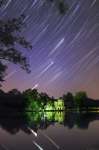 Trails in the Morning Sky
28.07.2012
Brilliant Venus and bright Jupiter still rise together before dawn. The peaceful waters by a small lakeside house near Stuttgart, Germany reflect their graceful arcing trails in this composited series of exposures, recorded on the morning of July 26.
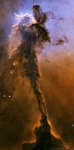 The Fairy of Eagle Nebula
25.09.2022
The dust sculptures of the Eagle Nebula are evaporating. As powerful starlight whittles away these cool cosmic mountains, the statuesque pillars that remain might be imagined as mythical beasts. Featured here is one of several striking dust pillars of the Eagle Nebula that might be described as a gigantic alien fairy.
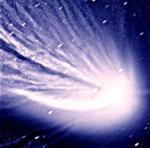 Detailing Hale-Bopp
8.05.1997
This enhanced composite image detailing structure in the coma and dust tail of Hale-Bopp was recorded May 5 - one day before the comet's passage from north to south across the plane of Earth's orbit.
 APOD: 2025 June 28 Б Lunar Farside
28.06.2025
Tidally locked in synchronous rotation, the Moon always presents its familiar nearside to denizens of planet Earth. From lunar orbit, the Moon's farside can become familiar, though. In fact this sharp picture, a mosaic from the Lunar Reconnaissance Orbiter's wide angle camera, is centered on the lunar farside.
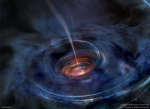 Black Hole Accreting with Jet
27.03.2017
What happens when a black hole devours a star? Many details remain unknown, but recent observations are providing new clues. In 2014, a powerful explosion was recorded by the ground-based robotic telescopes of the All Sky Automated Survey for SuperNovae (ASAS-SN) project, and followed up by instruments including NASA's Earth-orbiting Swift satellite.
 South Celestial Rocket Launch
28.02.2020
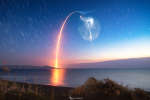
At sunset on December 6 a Rocket Lab Electron rocket was launched from a rotating planet. With multiple small satellites on board it departed on a mission to low Earth orbit dubbed Running Out of Fingers from Mahia Peninsula on New Zealand's north island.
 Lunar Farside
9.04.2011
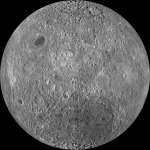
Tidally locked in synchronous rotation, the Moon always presents its familiar nearside to denizens of planet Earth. From lunar orbit, the Moon's farside can become familiar, though. In fact this sharp picture, a mosaic from the Lunar Reconnaissance Orbiter's wide angle camera, is centered on the lunar farside.
 Auroral Rocket Launch
31.01.2003
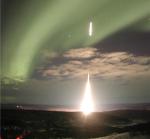
In this striking image, a rocket climbs skyward toward an expansive green auroral display in the first launch of 2003 from the University of Alaska's Poker Flat Research Range. Recorded on January 27th...
 A Jet from the Sun
10.12.2007
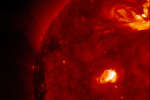
What powers the solar wind? Our Sun is known to emit a powerful wind of particles with gusts that can even affect astronauts and satellites orbiting Earth. The cause of the solar wind...
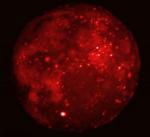 Eclipsed Moon in Infrared
23.04.2005
In September of 1996, the Midcourse Space Experiment (MSX) satellite had a spectacular view of a total lunar eclipse from Earth orbit. SPIRIT III, an on board infrared telescope, was used to repeatedly image the moon during the eclipse.
|
January February March April May June July August September October |
|||||||||||||||||||||||||||||||||||||||||||||||||