
|
You entered: Earth
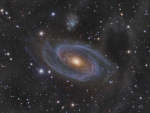 Grand Spiral Galaxy M81 and Arps Loop
16.04.2013
One of the brightest galaxies in planet Earth's sky is similar in size to our Milky Way Galaxy: big, beautiful M81. This grand spiral galaxy lies 11.8 million light-years away toward the northern constellation of the Great Bear (Ursa Major).
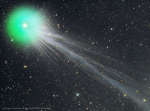 The Complex Ion Tail of Comet Lovejoy
20.01.2015
What causes the structure in Comet Lovejoy's tail? Comet C/2014 Q2 (Lovejoy), which is currently at naked-eye brightness and near its brightest, has been showing an exquisitely detailed ion tail. As the name...
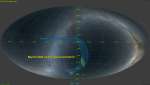 LIGO Virgo GW170814 Skymap
28.09.2017
From around planet Earth three gravitational wave detectors have now reported a joint detection of ripples in spacetime, the fourth announced detection of a binary black hole merger in the distant Universe. The event...
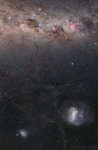 Galaxies and the South Celestial Pole
1.01.2021
The South Celestial Pole is easy to spot in star trail images of the southern sky. The extension of Earth's axis of rotation to the south, it's at the center of all the southern star trail arcs.
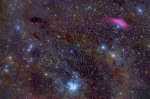 Comet PanSTARRS is near the Edge
16.02.2018
The comet PanSTARRS, also known as the blue comet (C/2016 R2), really is near the lower left edge of this stunning, wide field view recorded on January 13. Spanning nearly 20 degrees on the sky, the cosmic landscape is explored by well-exposed and processed frames from a sensitive digital camera.
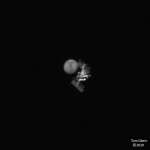 ISS Transits Mars
23.09.2020
Yes, but have you ever seen the space station do this? If you know when and where to look, watching the bright International Space Station (ISS) drift across your night sky is a fascinating sight -- but not very unusual.
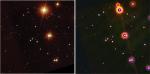 GRB 060218: A Mysterious Transient
27.02.2006
What is it? Something is happening in a small portion of the sky toward the constellation of Aries and telescopes around the globe are tracking an unusual transient there as it changes day by day. No one is sure what it will do next.
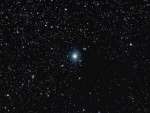 The Mystery of the Fading Star
8.01.2010
Every 27 years Epsilon Aurigae fades, remaining dim for roughly two years before growing bright again. Since the 19th century, astronomers have studied the mystery star, eventually arguing that Epsilon Aur, centered in this telescopic skyview, was actually undergoing a long eclipse by a dark companion object.
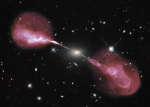 Plasma Jets from Radio Galaxy Hercules A
5.12.2012
Why does this galaxy emit such spectacular jets? No one is sure, but it is likely related to an active supermassive black hole at its center. The galaxy at the image center, Hercules A, appears to be a relatively normal elliptical galaxy in visible light.
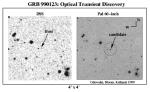 Galaxy And Gamma Ray Burst
25.01.1999
Gamma-ray bursts rule the high-energy sky and Saturday another brief, intense flash of gamma-rays from the cosmos triggered space-based detectors. The orbiting Compton Observatory's BATSE instrument quickly relayed the burst's approximate location to fast-slewing, ground-based cameras primed to search for an elusive optical flash.
|
January February March April May June July August September October |
|||||||||||||||||||||||||||||||||||||||||||||||||