
|
You entered: sunset
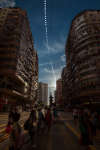 Eclipse Street, Hong Kong
25.06.2020
On June 21 an annular solar eclipse came soon after the solstice and our fair planet's northernmost sunset for 2020. At maximum eclipse, the New Moon in silhouette created a ring of fire visible along a narrow path at most 85 kilometers wide.
 APOD: 2025 August 12 Б Perseids from Perseus
12.08.2025
Where are all of these meteors coming from? In terms of direction on the sky, the pointed answer is the constellation of Perseus. That is why the meteor shower that peaks tonight is known as the Perseids -- the meteors all appear to come from a radiant toward Perseus.
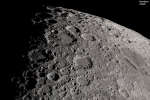 Southern Moonscape
6.02.2020
The Moon's south pole is near the top of this detailed telescopic view. Looking across the rugged southern lunar highlands it was captured from southern California, planet Earth. At the Moon's third quarter phase the lunar terminator, the sunset shadow line, is approaching from the left.
 APOD: 2024 January 8 Б The Phases of Venus
8.01.2024
Venus goes through phases. Just like our Moon, Venus can appear as a full circular disk, a thin crescent, or anything in between. Venus, frequently the brightest object in the post-sunset or pre-sunrise sky, appears so small, however, that it usually requires binoculars or a small telescope to clearly see its current phase.
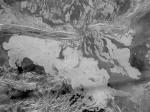 Lava Flows on Venus
23.03.2004
The hot surface of Venus shows clear signs of ancient lava flows. Evidence of this was bolstered by the robot spacecraft Magellan, which orbited Venus in the early 1990s. Using imaging radar, Magellan was able to peer beneath the thick perpetual clouds that cover Earth's closest planetary neighbor.
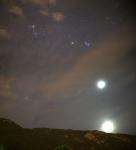 Moon and Planets Sky
26.03.2004
Look up into the sky tonight and without a telescope or binoculars you might have a view like this one of Moon, planets and stars. The lovely photo was taken on March 23rd, and captures the crescent Moon on the horizon with Venus above it. Both brilliant celestial bodies are over-exposed.
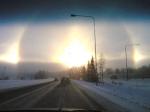 Driving Toward a Sun Halo
13.06.2006
What's happened to the Sun? Sometimes it looks like the Sun is being viewed through a large lens. In the above case, however, there are actually millions of lenses: ice crystals. As water freezes in the upper atmosphere, small, flat, six-sided, ice crystals might be formed.
 Milky Way with Airglow Australis
4.09.2015
After sunset on September 1, an exceptionally intense, reddish airglow flooded this Chilean winter night skyscape. Above a sea of clouds and flanking the celestial Milky Way, the airglow seems to ripple and flow across the northern horizon in atmospheric waves.
 APOD: 2024 April 29 Б Comet, Planet, Moon
29.04.2024
Three bright objects satisfied seasoned stargazers of the western sky just after sunset earlier this month. The most familiar was the Moon, seen on the upper left in a crescent phase. The rest of the Moon was faintly visible by sunlight first reflected by the Earth.
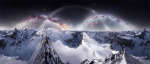 APOD: 2026 April 21 Б Three Sky Arches over Snowy Alps
21.04.2026
Why are there three arches across the sky instead of two? Last month, after being dropped off by a helicopter at a high mountain peak in the Alps near the Swiss Italian border, an adventurous astrophotographer expected two arches of our Milky Way galaxy to be visible during the night.
|
January February March April May June July August September |
|||||||||||||||||||||||||||||||||||||||||||||||||