
|
You entered: southern sky
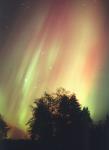 October Skylights
8.11.2000
With brilliant Venus above the western horizon at sunset and Jupiter and Saturn high in the east by early evening, November's night sky is filled with bright planets. October's sky featured bright planets as well and, triggered by the active Sun, some lovely auroral displays.
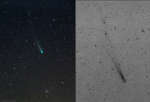 Active Comet ISON
16.11.2013
Falling through planet Earth's predawn skies toward its close encounter with the Sun on November 28, Comet ISON is coming to life. The much anticipated comet has now been reported to have substantially increased in brightness, surging to naked-eye visibility for dark sites and sprouting a more complex tail.
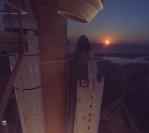 Discovery Spring
20.03.2001
Welcome to the equinox! Moving northward in Earth's sky, today the Sun crosses the celestial equator at 13:31 Universal Time bringing Spring to the north and Fall to the south. The change...
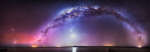 From the Northern to the Southern Cross
27.01.2019
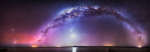
There is a road that connects the Northern to the Southern Cross but you have to be at the right place and time to see it. The road, as pictured here, is actually...
 From the Northern to the Southern Cross
27.01.2014
There is a road that connects the Northern to the Southern Cross but you have to be at the right place and time to see it. The road, as pictured above, is actually...
 Halley Dust and Milky Way
10.05.2019
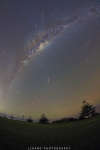
Grains of cosmic dust streaked through the mostly moonless night skies of May 7. Swept up as planet Earth plowed through the debris streams left behind by periodic Comet Halley, the annual meteor shower is known as the Eta Aquarids.
 A Partial Eclipse Over Manila Bay
11.02.2018
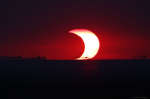
What's happened to the setting Sun? An eclipse! In early 2009, the Moon eclipsed part of the Sun as visible from parts of Africa, Australia, and Asia. In particular the featured image, taken from the Mall of Asia seawall, caught a partially eclipsed Sun setting over Manila Bay in the Philippines.
 APOD: 2025 September 18 Б Comet C/2025 R2 SWAN
18.09.2025
A new visitor from the outer Solar System, comet C/2025 R2 (SWAN) also known as SWAN25B was only discovered late last week, on September 11. That's just day before the comet reached perihelion, its closest approach to the Sun.
 Jupiter Season, Hawaiian Sky
2.06.2018
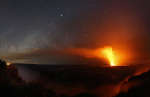
Volcanic activity on the Big Island of Hawaii has increased since this Hawaiian night skyscape was recorded earlier this year. Recent vents and lava flows are about 30 kilometers to the east, the direction...
 APOD: 2025 July 3 Б Nova V462 Lupi Now Visible
3.07.2025
If you know where to look, you can see a thermonuclear explosion from a white dwarf star. Possibly two. Such explosions are known as novas and the detonations are currently faintly visible with the unaided eye in Earth's southern hemisphere -- but are more easily seen with binoculars.
|
January February March April May June July August September |
|||||||||||||||||||||||||||||||||||||||||||||||||