
|
You entered: hot star
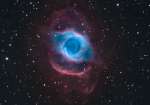 NGC 7293: The Helix Nebula
4.10.2012
A mere seven hundred light years from Earth, in the constellation Aquarius, a sun-like star is dying. Its last few thousand years have produced the Helix Nebula (NGC 7293), a well studied and nearby example of a Planetary Nebula, typical of this final phase of stellar evolution.
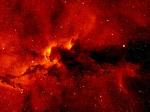 IC 1396 Close Up
30.09.2005
Clouds of glowing hydrogen gas mingle ominously with dark dust lanes in this close-up of IC 1396, an active star forming region some 2,000 light years away in the constellation Cepheus. In this and other similar emission nebulae, energetic ultraviolet light from a hot young star strips electrons from the surrounding hydrogen atoms.
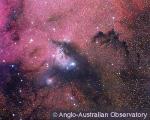 Reflections on NGC 6188
25.08.1999
NGC 6188 is an interstellar carnival of young blue stars, hot red gas, and cool dark dust. Located 4000 light years away in the disk of our Galaxy, NGC 6188 is home to the Ara OB1 association, a group of bright young stars whose nucleus forms the open cluster NGC 6193.
 APOD: 2025 April 20 Б The Orion Nebula in Visible and Infrared
19.04.2025
The Great Nebula in Orion is a colorful place. Visible to the unaided eye, it appears as a small fuzzy patch in the constellation of Orion. Long exposure, multi-wavelength images like this, however, show the Orion Nebula to be a busy neighborhood of young stars, hot gas, and dark dust.
 APOD: 2024 June 17 Б Ou4: The Giant Squid Nebula
16.06.2024
Squids on Earth aren't this big. This mysterious squid-like cosmic cloud spans nearly three full moons on planet Earth's sky. Discovered in 2011 by French astro-imager Nicolas Outters, the Squid Nebula's bipolar shape is distinguished here by the telltale blue emission from doubly ionized oxygen atoms.
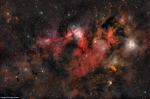 The Light, the Dark, and the Dusty
29.11.2022
This colorful skyscape spans about four full moons across nebula rich starfields along the plane of our Milky Way Galaxy in the royal northern constellation Cepheus. Near the edge of the region's massive...
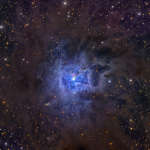 NGC 7023: The Iris Nebula
2.08.2014
These clouds of interstellar dust and gas have blossomed 1,300 light-years away in the fertile star fields of the constellation Cepheus. Sometimes called the Iris Nebula, NGC 7023 is not the only nebula in the sky to evoke the imagery of flowers, though.
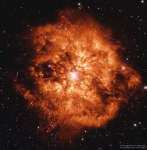 Wolf Rayet Star 124: Stellar Wind Machine
7.03.2020
Some stars explode in slow motion. Rare, massive Wolf-Rayet stars are so tumultuous and hot that they are slowly disintegrating right before our telescopes. Glowing gas globs each typically over 30 times more massive than the Earth are being expelled by violent stellar winds.
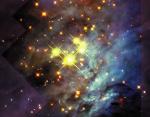 The Brown Dwarfs of Orions Trapezium
30.08.2000
The bright stars above are well known as heart of the Trapezium, an open cluster of stars in the center of the Orion Nebula. The many dim objects, however, are not well known, and have come to attention only on recent images in infrared light.
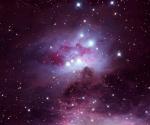 Reflections on the 1970s
2.10.2003
The 1970s are often overlooked. In particular, the beautiful grouping of reflection nebulae NGC 1977, NGC 1975, and NGC 1973 in Orion are often overlooked in favor of the substantial stellar nursery better known as the Orion Nebula.
|
January February |
|||||||||||||||||||||||||||||||||||||||||||||||||