
|
You entered: gas
 APOD: 2024 November 27 Б The Meteor and the Comet
27.11.2024
How different are these two streaks? The streak on the upper right is Comet Tsuchinshan-Atlas showing an impressive dust tail. The comet is a large and dirty iceberg that entered the inner Solar System and is shedding gas and dust as it is warmed by the Sun's light.
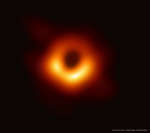 First Horizon Scale Image of a Black Hole
1.05.2022
What does a black hole look like? To find out, radio telescopes from around the Earth coordinated observations of black holes with the largest known event horizons on the sky. Alone, black holes are just black, but these monster attractors are known to be surrounded by glowing gas.
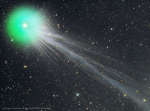 The Complex Ion Tail of Comet Lovejoy
20.01.2015
What causes the structure in Comet Lovejoy's tail? Comet C/2014 Q2 (Lovejoy), which is currently at naked-eye brightness and near its brightest, has been showing an exquisitely detailed ion tail. As the name...
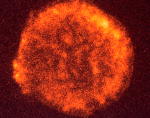 Tycho's Supernova Remnant in X-ray
23.06.1996
How often do stars explode? By looking at external galaxies, astronomers can guess that these events, known as a supernovae, should occur about once every 30 years in a typical spiral galaxy like our MilkyWay.
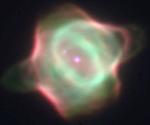 Hen 1357: New Born Nebula
3.04.1998
This Hubble Space Telescope picture shows Hen-1357, the youngest known planetary nebula. Graceful, gentle curves and symmetry suggest its popular name - The Stingray Nebula. Observations in the 1970s detected no nebular material, but this image from March 1996 clearly shows the Stingray's emerging bubbles and rings of shocked and ionized gas.
 The Cat's Eye Nebula
31.10.1999
Three thousand light-years away, a dying star throws off shells of glowing gas. This image from the Hubble Space Telescope reveals The Cat's Eye Nebula to be one of the most complex planetary nebulae known.
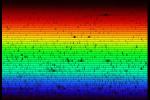 The Solar Spectrum
29.06.2003
It is still not known why the Sun's light is missing some colors. Shown above are all the visible colors of the Sun, produced by passing the Sun's light through a prism-like device.
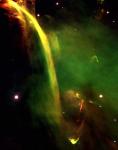 Arcs and Jets in Herbig Haro 34
29.11.1999
Some features of HH-34 are understood -- some are not. At the core of Herbig-Haro 34 lies a seemingly typical young star. This star, though, somehow ejects energetic "bullets" of high-energy particles, appearing as red streaks toward the lower right of the this image.
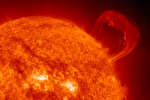 A Solar Prominence from SOHO
31.05.2009
How can gas float above the Sun? Twisted magnetic fields arching from the solar surface can trap ionized gas, suspending it in huge looping structures. These majestic plasma arches are seen as prominences above the solar limb.
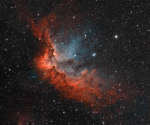 NGC 7380: The Wizard Nebula
2.11.2011
What powers are being wielded in the Wizard Nebula? Gravitation strong enough to form stars, and stellar winds and radiations powerful enough to create and dissolve towers of gas. Located only 8,000 light years away, the Wizard nebula, pictured above, surrounds developing open star cluster NGC 7380.
|
January February March April May |
|||||||||||||||||||||||||||||||||||||||||||||||||