
|
You entered: image
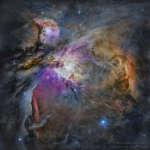 Orion Nebula: The Hubble View
29.06.2021
Few cosmic vistas excite the imagination like the Orion Nebula. Also known as M42, the nebula's glowing gas surrounds hot young stars at the edge of an immense interstellar molecular cloud only 1,500 light-years away.
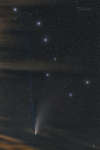 Remembering NEOWISE
31.07.2021
It was just last July. If you could see the stars of the Big Dipper, you could find Comet NEOWISE in your evening sky. After sunset denizens of the north could look for the naked-eye comet below the bowl of that famous celestial kitchen utensil and above the northwestern horizon.
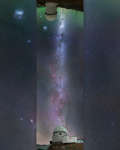 A 10 000 Kilometer Galactic Bridge
3.06.2022
With this creative astro-collaboration you can follow the plane of our Milky Way Galaxy as it bridges northern and southern hemisphere skies. To construct the expansive composite nightscape, skies over Observatorio El Sauce...
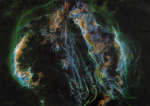 Supernova Remnant: The Veil Nebula
22.06.2022
Ten thousand years ago, before the dawn of recorded human history, a new light would have suddenly have appeared in the night sky and faded after a few weeks. Today we know this light was from a supernova, or exploding star, and record the expanding debris cloud as the Veil Nebula, a supernova remnant.
 APOD: 2023 August 22 Б The Pistachio Nebula
22.08.2023
This nebula had never been noted before. Newly discovered nebulas are usually angularly small and found by professionals using large telescopes. In contrast, the Pistachio Nebula was discovered by dedicated amateurs and, although faint, is nearly the size of the full Moon.
 APOD: 2023 August 28 Б Star Formation in the Pacman Nebula
28.08.2023
Look through the cosmic cloud cataloged as NGC 281 and you might miss the stars of open cluster IC 1590. Formed within the nebula, that cluster's young, massive stars ultimately power the pervasive nebular glow.
 APOD: 2023 November 27 Б LBN 86: The Eagle Ray Nebula
27.11.2023
This eagle ray glides across a cosmic sea. Officially cataloged as SH2-63 and LBN 86, the dark nebula is composed of gas and dust that just happens to appear shaped like a common ocean fish. The interstellar dust nebula appears light brown as it blocks and reddens visible light emitted behind it.
 APOD: 2023 December 6 Б Stars Verus Dust in the Carina Nebula
6.12.2023
It's stars versus dust in the Carina Nebula and the stars are winning. More precisely, the energetic light and winds from massive newly formed stars are evaporating and dispersing the dusty stellar nurseries in which they formed.
 Jupiter over 2 Hours and 30 Minutes
19.01.2024
Jupiter, our Solar System's ruling gas giant, is also the fastest spinning planet, rotating once in less than 10 hours. The gas giant doesn't rotate like a solid body though.
 Mars Passing By
2.08.2024
As Mars wanders through Earth's night, it passes about 5 degrees south of the Pleiades star cluster in this composite astrophoto. The skyview was constructed from a series of images captured over a run of 16 consecutive clear nights beginning on July 12.
|
January February March April May June July August September |
|||||||||||||||||||||||||||||||||||||||||||||||||