
|
You entered: stars
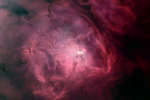 Gas and Dust of the Lagoon Nebula
15.07.2008
This beautiful cosmic cloud is a popular stop on telescopic tours of the constellation Sagittarius. Eighteenth century cosmic tourist Charles Messier cataloged the bright nebula as M8, while modern day astronomers recognize the Lagoon...
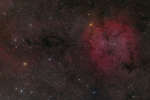 IC 1396 and Surrounding Starfield
19.08.2009
Sprawling across hundreds of light-years, emission nebula IC 1396, visible on the upper right, mixes glowing cosmic gas and dark dust clouds. Stars are forming in this area, only about 3,000 light-years from Earth. This wide angle view also captures surrounding emission and absorption nebula.
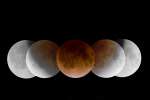 The Umbra of Earth
15.12.2011
The dark, inner shadow of planet Earth is called the umbra. Shaped like a cone extending into space, it has a circular cross section most easily seen during a lunar eclipse. For example, last Saturday the Full Moon slid across the southern half of Earth's umbral shadow, entertaining moonwatchers around much of the planet.
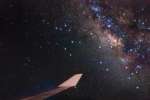 New York to London Milky Way
14.06.2014
Bright stars of Sagittarius and the center of our Milky Way Galaxy lie just off the wing of a Boeing 747 in this astronomical travel photo. The stratospheric scene was captured earlier this month during a flight from New York to London, 11,0000 meters above the Atlantic Ocean.
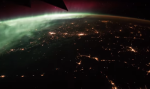 Flying over the Earth at Night II
12.03.2018
What would it be like to orbit the Earth? The International Space Station (ISS) does this every 90 minutes, and sometimes the astronauts on board take image sequences that are made into videos. The featured time-lapse video shows many visual spectacles of the dark Earth below.
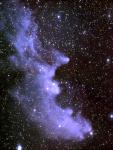 The Witch Head Nebula
27.02.2001
Double, double toil and trouble; Fire burn, and cauldron bubble -- maybe Macbeth should have consulted the Witch Head Nebula. This suggestively shaped reflection nebula is associated with the bright star Rigel in the constellation Orion.
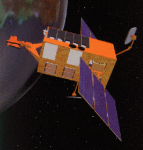 The X-ray Timing Explorer
3.01.1996
Launched Saturday on a Delta rocket, the X-ray Timing Explorer (XTE) will watch the sky for rapid changes in X-rays. XTE carries three separate X-ray telescopes. The Proportional Counter Array (PCA) and the High Energy X-ray Timing Experiment (HEXTE) will provide the best timing information in the widest X-ray energy range yet available.
 M78 and Reflecting Dust Clouds in Orion
18.03.2008
An eerie blue glow and ominous columns of dark dust highlight M78 and other bright reflection nebula in the constellation of Orion. The dark filamentary dust not only absorbs light, but also reflects the light of several bright blue stars that formed recently in the nebula.
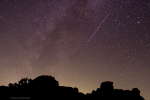 Perseid Trail
14.08.2008
This bright and colorful meteor flashed through Tuesday's early morning skies, part of the annual Perseid Meteor Shower. The lovely image is one of over 350 frames captured on August 12 from...
 SDO: The Extreme Ultraviolet Sun
23.04.2010
Don't panic, the Sun has not gone wild. But this wild-looking portrait of the nearest star to planet Earth was made on March 30th by the recently launched Solar Dynamics Observatory (SDO). Shown in false-color, the composite view covers extreme ultraviolet wavelengths and traces hot plasma at temperatures approaching 1 million kelvins.
|
January February March April May June July August September October |
|||||||||||||||||||||||||||||||||||||||||||||||||