
|
You entered: new moon
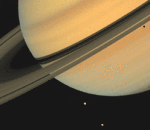 Saturn with Moons Tethys and Dione
31.05.1997
Saturn and two of its larger moons - Tethys and Dione - were photographed by the Voyager 1 spacecraft which flew by the planet in November of 1980. This picture gives an indication of Saturn's extensive ring system, which can be seen casting a shadow on the planet, as does Tethys.
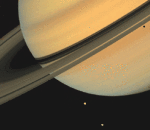 Saturn with Moons Tethys and Dione
18.03.1996
Saturn and two of its larger moons - Tethys and Dione - were photographed by the Voyager 1 spacecraft which flew by the planet in November of 1980. This picture gives an indication of Saturn's extensive ring system, which can be seen casting a shadow on the planet, as does Tethys.
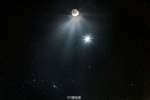 Comet Meets Moon and Morning Star
12.12.2015
A crescent Moon and brilliant Venus met in predawn skies on December 7, a beautiful conjunction of planet Earth's two brightest celestial beacons after the Sun. Harder to see but also on the scene was Comet Catalina (C/2013 US10).
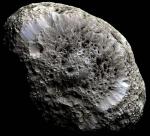 Saturns Hyperion: A Moon with Odd Craters
3.10.2005
What lies at the bottom of Hyperion's strange craters? Nobody knows. To help find out, the robot Cassini spacecraft now orbiting Saturn swooped past the sponge-textured moon again last week and took an image of unprecedented detail.
 APOD: 2025 January 12 Б Mimas: Small Moon with a Big Crater
12.01.2025
Whatever hit Mimas nearly destroyed it. What remains is one of the largest impact craters on one of Saturn's smallest round moons. Analysis indicates that a slightly larger impact would have destroyed Mimas entirely.
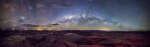 Milky Way over Moon Valley
4.12.2014
Our Milky Way Galaxy arcs over a desolate landscape in this fantastic panoramic night skyview. The otherworldly scene looks across the arid, eroded terrain of the Valle de la Luna in the Chilean Atacama desert.
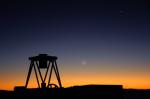 Hauoli Makahiki Hou
4.01.2006
Fading sunlight, a young crescent Moon, and brilliant Venus shared the western sky in this view of 2005's final sunset from the top of Mount Haleakala, on Maui, Hawaii. Also known as the Sacred House of the Sun, Haleakala, is Maui's dormant volcano.
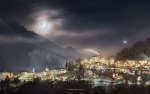 A Lunar Corona with Jupiter and Saturn
19.01.2021
Why does a cloudy moon sometimes appear colorful? The effect, called a lunar corona, is created by the quantum mechanical diffraction of light around individual, similarly-sized water droplets in an intervening but mostly-transparent cloud. Since light of different colors has different wavelengths, each color diffracts differently.
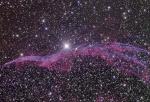 NGC 6960: The Witch's Broom Nebula
1.01.2003
Ten thousand years ago, before the dawn of recorded human history, a new light must suddenly have appeared in the night sky and faded after a few weeks. Today we know this light was an exploding star and record the colorful expanding cloud as the Veil Nebula.
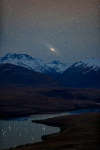 Andromeda in Southern Skies
21.10.2022
Looking north from southern New Zealand, the Andromeda Galaxy never gets more than about five degrees above the horizon. As spring comes to the southern hemisphere, in late September Andromeda is highest in the sky around midnight though.
|
January February March April May June July August September |
|||||||||||||||||||||||||||||||||||||||||||||||||