
|
You entered: galaxy center
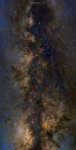 Great Rift Near the Center of the Milky Way
10.11.2016
Over 100 telescopic image panels in this stunning vertical mosaic span about 50 degrees across the night sky. They follow part of the Great Rift, the dark river of dust and molecular gas that stretches along the plane of our Milky Way Galaxy.
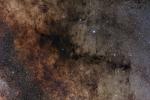 East of Antares
23.06.2006
East of Antares, dark markings seem to sprawl through the crowded star fields toward the center of our Milky Way Galaxy. Cataloged in the early 20th century by astronomer E. E. Barnard, the obscuring interstellar dust clouds include B72, B77, B78, and B59, seen in silhouette against the starry background.
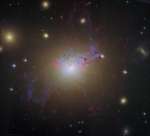 Hubble Remix: Active Galaxy NGC 1275
4.06.2010
Active galaxy NGC 1275 is the central, dominant member of the large and relatively nearby Perseus Cluster of Galaxies. Wild-looking at visible wavelengths, the active galaxy is also a prodigious source of x-rays and radio emission.
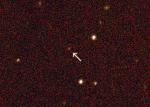 Redshift 5.8: A New Farthest Quasar
19.04.2000
The distance record for a quasar has been broken yet again. At the present time, no other object in the universe has been found to be more distant than the above speck. The recently discovered quasar has been clocked at redshift 5.82.
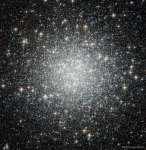 Blue Straggler Stars in Globular Cluster M53
7.02.2021
If our Sun were part of this star cluster, the night sky would glow like a jewel box of bright stars. This cluster, known as M53 and cataloged as NGC 5024, is one of about 250 globular clusters that survive in our Galaxy.
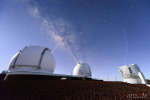 Four Lasers over Mauna Kea
23.06.2014
Are lasers from giant telescopes being used to attack the Galactic center? No. Lasers shot from telescopes are now commonly used to help increase the accuracy of astronomical observations. In some sky locations, Earth...
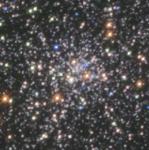 At The Core Of M15
17.01.1998
Densely packed stars in the core of the globular cluster M15 are shown in this Hubble Space Telescope (HST) image. The star colors roughly indicate their temperatures - hot stars appear blue, cooler stars look reddish-orange.
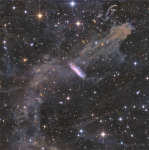 A Galaxy Beyond Stars, Gas, Dust
19.10.2022
Do we dare believe our eyes? When we look at images of space, we often wonder whether they are "real", and just as often the best answer varies. In this case, the scene appears...
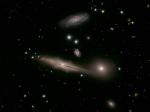 Galaxy Group HCG 87
31.07.2003
Posing for this cosmic family photo are the galaxies of HCG (Hickson Compact Group) 87, about four hundred million light-years distant toward the amphibious constellation Capricornus. The large edge-on spiral near picture center...
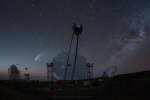 MAGIC NEOWISE
24.07.2020
The multi-mirror, 17 meter-diameter MAGIC telescopes reflect this starry night sky from the Roque de los Muchachos European Northern Observatory on the Canary Island of La Palma. MAGIC stands for Major Atmospheric Gamma Imaging...
|
January February March April May June July August |
||||||||||||||||||||||||||||||||||||||||||||||||||||||||