
|
You entered: all sky
 Landing on Mars: Seven Minutes of Terror
14.02.2021
Starting Thursday, there may be an amazing new robotic explorer on Mars. Or there may be a new pile of junk. It all likely depends on things going correctly in the minutes after the Mars 2020 mission arrives at its new home planet and attempts to deploy the Perseverance rover.
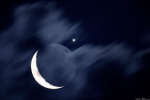 Moon Meets Jupiter
9.07.2016
What's that next to the Moon? Jupiter -- and its four largest moons. Skygazers around planet Earth enjoyed the close encounter of planets and Moon in 2012 July 15's predawn skies. And while...
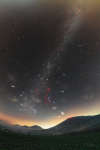 Seven Years of Halley Dust
27.10.2022
History's first known periodic comet Halley (1P/Halley) returns to the inner Solar System every 75 years or so. The famous comet made its last appearance to the naked-eye in 1986. But dusty debris...
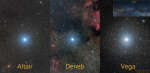 Stars of a Summer Triangle
26.06.2015
Rising at the start of a northern summer's night, these three bright stars form the familiar asterism known as the Summer Triangle. Altair, Deneb, and Vega are the alpha stars of their respective constellations, Aquila, Cygnus, and Lyra, nestled near the Milky Way.
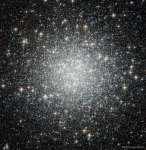 Blue Straggler Stars in Globular Cluster M53
6.02.2021
If our Sun were part of this star cluster, the night sky would glow like a jewel box of bright stars. This cluster, known as M53 and cataloged as NGC 5024, is one of about 250 globular clusters that survive in our Galaxy.
 Curiosity Before Mars: Seven Minutes of Terror
31.07.2012
Next week at this time, there may be an amazing new robotic explorer on Mars. Or there may be a new pile of junk. It all likely depends on many things going correctly in the minutes after the Mars Science Laboratory mission arrives at Mars and attempts to deploy the Curiosity rover from orbit.
 USNO A2.0 Catalog: A Digital Sky
26.04.1999
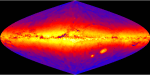
Here lie 526,230,881 of the brightest stars known. The US Naval Observatory has deployed their monster Precision Measuring Machine to digitize photographic plates covering the whole sky and creating the above map. Yellow corresponds to 150,000 stars per square degree, while dark blue corresponds to only 500 stars per square degree.
 Cabin Under the Stars
16.01.2019
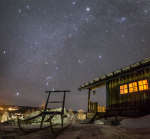
Gocka's, a family nickname for the mountain cabin, and a wooden sled from a generation past stand quietly under the stars. The single exposure image was taken on January 6 from Tanndalen Sweden to evoke a simple visual experience of the dark mountain skies.
 Globular Star Cluster NGC 6752
24.10.2024
Some 13,000 light-years away toward the southern constellation Pavo, the globular star cluster NGC 6752 roams the halo of our Milky Way galaxy. Over 10 billion years old, NGC 6752 follows clusters Omega Centauri, 47 Tucanae, and Messier 22 as the fourth brightest globular in planet Earth's night sky.
 The Owl and the Galaxy
1.04.2015
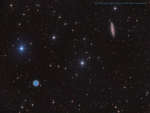
The Owl and the Galaxy sail these skies With blue and yellow star. They go together beneath the Big Dipper, If you wonder where they are. The Galaxy's light shines through the night, Ten millions of light-years away. But never fear the Owl is near, Inside the Milky Way.
|
January February March April May June July August September |
|||||||||||||||||||||||||||||||||||||||||||||||||