
|
You entered: Orion
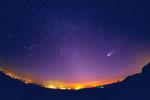 Sirius: The Brightest Star in the Night
11.06.2000
Sirius is the brightest star in the night sky. Sirius is visible on the far left of the above photograph, to the left of the constellation of Orion and Comet Hale-Bopp. Intrinsically, Sirius is over 20 times brighter than our Sun and over twice as massive.
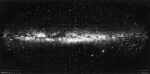 7,000 Stars And The Milky Way
13.02.1996
This panorama view of the sky is really a drawing. It was made in the 1940s under the supervision of astronomer Knut Lundmark at the Lund Observatory in Sweden. To create the picture, draftsmen...
 The Tarantula Nebula
6.01.2006
First cataloged as a star, 30 Doradus is actually an immense star forming region in nearby galaxy The Large Magellanic Cloud. The region's spidery appearance is responsible for its popular name, the Tarantula Nebula, except that this tarantula is about 1,000 light-years across, and 180,000 light-years away in the southern constellation Dorado.
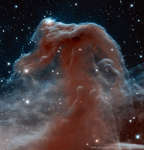 The Horsehead Nebula in Infrared from Hubble
8.06.2016
While drifting through the cosmos, a magnificent interstellar dust cloud became sculpted by stellar winds and radiation to assume a recognizable shape. Fittingly named the Horsehead Nebula, it is embedded in the vast and complex Orion Nebula (M42).
 APOD: 2023 November 20 Б The Horsehead Nebula
20.11.2023
Sculpted by stellar winds and radiation, a magnificent interstellar dust cloud by chance has assumed this recognizable shape. Fittingly named the Horsehead Nebula, it is some 1,500 light-years distant, embedded in the vast Orion cloud complex.
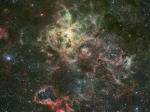 Tentacles of the Tarantula Nebula
22.08.2007
The largest, most violent star forming region known in the whole Local Group of galaxies lays in our neighboring galaxy the Large Magellanic Cloud (LMC). Were the Tarantula Nebula at the distance of the Orion Nebula -- a local star forming region -- it would take up fully half the sky.
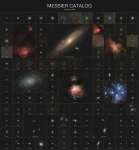 APOD: 2026 May 14 Б The Messier Catalog at Uniform Scale
14.05.2026
What are some of the most interesting astronomical objects you can see in the night sky? Armed with a good pair of binoculars or a small telescope, if you live in the Northern Hemisphere, you can look for the very popular objects in the Messier Catalog.
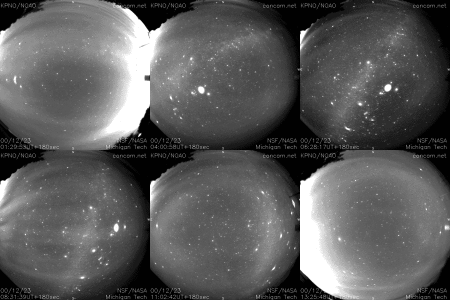 Watch the Sky Rotate
10.01.2001
If you could watch the sky for an entire night, what would you see? The above time-lapse sequence from the CONtinuous CAMera (CONCAM) project shows the answer for the skies above Kitt Peak National Observatory on 2000 December 23.
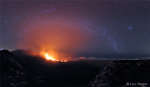 The Milky Way Over the Peak of the Furnace
1.11.2010
On Reunion Island, it is known simply as "The Volcano." To others, it is known as the Piton de la Fournaise, which is French for the Peak of the Furnace. It is one of the most active volcanoes in the world.
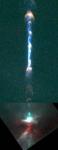 HH111's 12 Light-Year Star Jet
21.03.2000
The complex interactions of three stars in the Orion B molecular cloud complex have resulted in the ejection of particles along a 12 light-year long jet. One of the stars in the HH111 system has apparently also been ejected leaving two stars tightly bound in a binary orbit.
|
January February March April May June July August September |
|||||||||||||||||||||||||||||||||||||||||||||||||