
|
You entered: ultraviolet
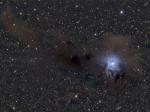 Wisps of the Iris Nebula
26.06.2007
Like delicate cosmic petals, these clouds of interstellar dust and gas have blossomed 1,300 light-years away in the fertile star fields of the constellation Cepheus. Sometimes called the Iris Nebula and dutifully cataloged as NGC 7023, this is not the only nebula in the sky to evoke the imagery of flowers.
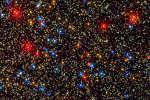 The Center of Globular Cluster Omega Centauri
14.09.2009
What is left over after stars collide? To help answer this question, astronomers have been studying the center of the most massive ball of stars in our Milky Way Galaxy. In the center of globular cluster Omega Centauri, stars are packed in 10,000 times more densely than near our Sun.
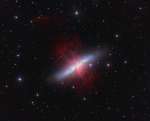 M82: Starburst Galaxy with a Superwind
4.07.2013
Also known as the Cigar Galaxy for its elongated visual appearance, M82 is a starburst galaxy with a superwind. In fact, through ensuing supernova explosions and powerful winds from massive stars, the burst of star formation in M82 is driving a prodigious outflow of material.
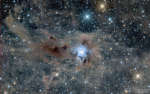 The Iris Nebula in a Field of Dust
31.07.2018
What blue flower grows in this field of dark interstellar dust? The Iris Nebula. The striking blue color of the Iris Nebula is created by light from the bright star SAO 19158 reflecting off of a dense patch of normally dark dust.
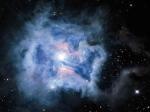 The Iris Nebula from CFHT
28.12.2005
Like delicate cosmic petals, these clouds of interstellar dust and gas have blossomed 1,300 light-years away in the fertile star fields of the constellation Cepheus. Sometimes called the Iris Nebula and dutifully cataloged as NGC 7023, this is not the only nebula in the sky to evoke the imagery of flowers.
 The Ghosts of Gamma Cas
27.10.2023
Gamma Cassiopeiae shines high in northern autumn evening skies. It's the brightest spiky star in this telescopic field of view toward the constellation Cassiopeia. Gamma Cas shares the ethereal-looking scene with ghostly interstellar clouds of gas and dust, IC 59 (top left) and IC 63.
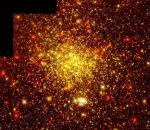 NGC1850: Star Cluster in the LMC
20.06.1997
NGC1850 is a large cluster of stars located a mere 166,000 light-years from Earth in our neighboring galaxy the Large Magellanic Cloud (LMC). The colors in this beautiful Hubble Space Telescope composite image of the cluster reveal different populations of stars.
 APOD: 2024 May 28 Б Solar X Flare as Famous Active Region Returns
27.05.2024
It's back. The famous active region on the Sun that created auroras visible around the Earth earlier this month has survived its rotation around the far side of the Sun -- and returned. Yesterday...
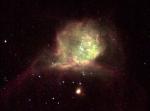 Star Forming Region Hubble X
15.02.2001
In nearby galaxy NGC 6822, this glowing emission nebula complex surrounds bright, massive, newborn stars. A mere 4 million years young, these stars condensed from the galaxy's interstellar gas and dust clouds.
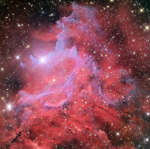 Flaming Star Nebula
30.11.2016
A runaway star lights the Flaming Star Nebula in this cosmic scene. Otherwise known as IC 405, the Flaming Star Nebula's billowing interstellar clouds of gas and dust lie about 1,500 light-years away toward the constellation of Auriga.
|
January February March April May June July August September |
|||||||||||||||||||||||||||||||||||||||||||||||||