
|
You entered: star system
 On the Origin of Gold
15.05.2005
Where did the gold in your jewelry originate? No one is completely sure. The relative average abundance in our Solar System appears higher than can be made in the early universe, in stars, and even in typical supernova explosions.
 The Planet, the White Dwarf, and the Neutron Star
18.07.2003
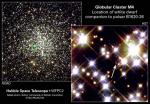
A planet, a white dwarf, and a neutron star orbit each other in the giant globular star cluster M4, some 5,600 light-years away. The most visible member of the trio is the white...
 On the Origin of Gold
5.04.2001
Where did the gold in your jewelry originate? No one is completely sure. The relative average abundance in our Solar System appears higher than can be made in the early universe, in stars, and even in typical supernova explosions. Some astronomers now
 On the Origin of Gold
15.10.2017
Where did the gold in your jewelry originate? No one is completely sure. The relative average abundance in our Solar System appears higher than can be made in the early universe, in stars, and even in typical supernova explosions.
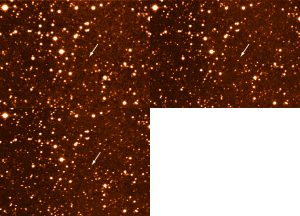 Quaoar: Large Asteroid in the Outer Solar System
9.10.2002
Asteroids almost as large as planets are still being discovered in our own Solar System. Recently an asteroid more than half the size of Pluto was found orbiting at a distance only a little further than the Solar System's most distant planet.
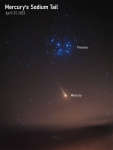 Mercurys Sodium Tail
3.05.2022
That's no comet. Below the Pleiades star cluster is actually a planet: Mercury. Long exposures of our Solar System's innermost planet may reveal something unexpected: a tail. Mercury's thin atmosphere contains small amounts of sodium that glow when excited by light from the Sun.
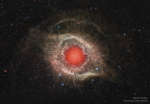 The Helix Nebula in Infrared
20.09.2016
What makes this cosmic eye look so red? Dust. The featured image from the robotic Spitzer Space Telescope shows infrared light from the well-studied Helix Nebula (NGC 7293) a mere 700 light-years away in the constellation of the Water Carrier Aquarius.
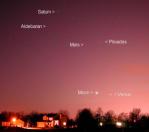 Planets in the West
18.04.2002
Have you seen any bright planets lately? Chances are if you've been outside under clear skies just after sunset, then you have. Now shining in the west as bright "stars" in the night sky, are all five planets of the solar system known to ancient astronomers - Mercury, Venus, Mars, Saturn, and Jupiter.
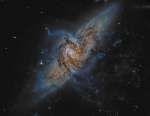 NGC 3314: When Galaxies Overlap
15.07.2011
NGC 3314 is actually two large spiral galaxies which just happen to almost exactly line up. The foreground spiral is viewed nearly face-on, its pinwheel shape defined by young bright star clusters. But against the glow of the background galaxy, dark swirling lanes of interstellar dust appear to dominate the face-on spiral's structure.
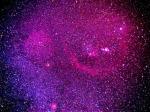 Orion: The Big Picture
1.12.1997
Orion is big. Some of the stars that form the constellation of Orion are part of a giant gas cloud complex that stretches over 100 light years and appears more than 50 times the diameter of the Moon.
|
January February March April May June |
|||||||||||||||||||||||||||||||||||||||||||||||||