
|
You entered: rocks
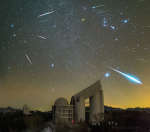 Geminid Meteors over Xinglong Observatory
23.12.2015
Where do Geminid meteors come from? In terms of location on the sky, as the featured image composite beautifully demonstrates, the sand-sized bits of rock that create the streaks of the Geminid Meteor Shower appear to flow out from the constellation of Gemini.
 APOD: 2024 December 16 Б A Kilometer High Cliff on Comet Churyumov Gerasimenko
16.12.2024
This kilometer high cliff occurs on the surface of a comet. It was discovered on the dark nucleus of Comet Churyumov - Gerasimenko (CG) by Rosetta, a robotic spacecraft launched by ESA, which orbited the comet from 2014 to 2016. The ragged cliff, as featured here, was imaged by Rosetta early in its mission.
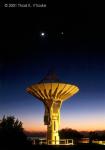 Bright Venus
8.03.2001
Have you seen a bright evening star in the western sky lately? That's no star, that's planet Venus the second "rock" from the Sun. Blazing at -4.6 magnitude, Venus, after the Sun and Moon, is the third brightest celestial body in planet Earth's sky.
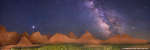 The Milky Way Over the Badlands
18.08.2009
Why take a picture of just the Badlands when you can take one that also shows the spectacular sky above it? Just such a picture, actually a digital stitched panorama of four images, was taken in late June near midnight, looking southwest.
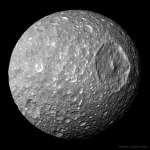 Mimas: Small Moon with a Big Crater
31.05.2021
Whatever hit Mimas nearly destroyed it. What remains is one of the largest impact craters on one of Saturn's smallest round moons. Analysis indicates that a slightly larger impact would have destroyed Mimas entirely.
 Perseverance Sol 354
25.02.2022
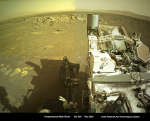
This Navcam mosaic from Perseverance looks out over the car-sized rover's deck, across the floor of Jezero crater on Mars. Frames used to construct the mosaic view were captured on mission sol 354. That corresponds to Earth calendar date February 17, 2022, nearly one Earth year after the rover's landing.
 APOD: 2026 March 31 Б Uranus Largest Moon: Titania
31.03.2026
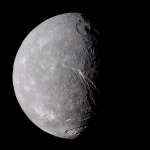
Titania's tortured terrain is a mix of canyons, cliffs, and craters. NASA's interplanetary robot spacecraft Voyager 2 passed the largest moon of Uranus in 1986 and took the feature picture. That...
 Europa Rotating
16.01.2001
Evidence has been mounting that beneath the vast planes of ice that cover Europa lies water -- liquid oceans that might be home to alien life. The smallest of Jupiter's Galilean Moons (which include Io, Ganymede, and Callisto), Europa's deep interior is composed of mostly of silicate rock.
 Sojourner's View: The Sagan Memorial Station
10.07.1997
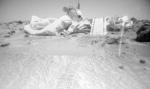
The robot rover Sojourner sees Mars from the perspective of a house cat. During the 7 month cruise to Mars aboard the Pathfinder spacecraft, Sojourner measured only seven inches tall in a stowed position but prowling the martian landscape it has stretched to its full height of 1 foot (30 centimeters).
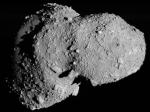 The Missing Craters of Asteroid Itokawa
21.11.2005
Where are the craters on asteroid Itokawa? No one knows. The Japanese robot probe Hayabusa recently approached the Earth-crossing asteroid and is returning pictures showing a surface unlike any other Solar System body yet photographed -- a surface possibly devoid of craters.
|
January February March April May June July August September |
|||||||||||||||||||||||||||||||||||||||||||||||||