
|
You entered: new moon
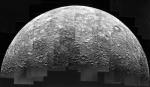 Mercury: A Cratered Inferno
19.08.2001
Mercury's surface looks similar to our Moon's. Each is heavily cratered and made of rock. Mercury's diameter is about 4800 km, while the Moon's is slightly less at about 3500 km (compared with about 12,700 km for the Earth). But Mercury is unique in many ways.
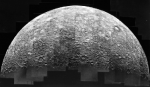 Mercury: A Cratered Inferno
12.09.1996
Mercury's surface looks similar to our Moon's. Each is heavily cratered and made of rock. Mercury's diameter is about 4800 km, while the Moon's is slightly less at about 3500 km (compared with about 12,700 km for the Earth). But Mercury is unique in many ways.
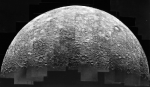 Mercury: A Cratered Inferno
30.11.1997
Mercury's surface looks similar to our Moon's. Each is heavily cratered and made of rock. Mercury's diameter is about 4800 km, while the Moon's is slightly less at about 3500 km (compared with about 12,700 km for the Earth). But Mercury is unique in many ways.
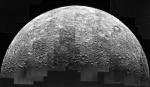 Mercury: A Cratered Inferno
2.01.1999
Mercury's surface looks similar to our Moon's. Each is heavily cratered and made of rock. Mercury's diameter is about 4800 km, while the Moon's is slightly less at about 3500 km (compared with about 12,700 km for the Earth). But Mercury is unique in many ways.
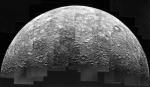 Mercury: A Cratered Inferno
12.09.2004
Mercury's surface looks similar to our Moon's. Each is heavily cratered and made of rock. Mercury's diameter is about 4800 km, while the Moon's is slightly less at about 3500 km (compared with about 12,700 km for the Earth). But Mercury is unique in many ways.
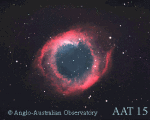 NGC 7293: The Helix Nebula
17.04.1996
The Helix nebula (New General Catalog number 7293) is estimated to be a mere 450 light-years from the Sun, in the direction of the constellation Aquarius. At that distance it may well be the closest planetary nebula, offering a dramatic snapshot of a brief final evolutionary stage in the life of a solar-type star.
 APOD: 2023 November 8 Б Perseus Galaxy Cluster from Euclid
8.11.2023
There's a new space telescope in the sky: Euclid. Equipped with two large panoramic cameras, Euclid captures light from the visible to the near-infrared. It took five hours of observing for Euclid...
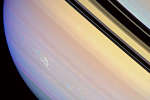 A Persistent Electrical Storm on Saturn
5.05.2008
How do large storms evolve on Saturn? On Earth, a hurricane can persist for weeks, while the Great Red Spot on Jupiter has been in existence for over 150 years. On Saturn, a storm system has now set a new endurance record, now being discernable for greater than three months.
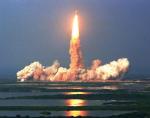 Happy 40th Birthday NASA
1.10.1998
Happy Birthday, NASA! The National Aeronautics and Space Administration officially began operations on October 1, 1958, absorbing its forerunner organization the National Advisory Committee for Aeronautics, NACA. Its landmark achievements in human spaceflight include...
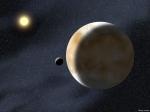 Eris: More Massive than Pluto
19.06.2007
Eris, a dwarf planet currently orbiting the Sun at about twice Pluto's distance, has been measured to have about 27 percent more mass than Pluto. The mass was calculated by timing the orbit of Eris' moon Dysnomia.
|
January February March April May June July August September |
|||||||||||||||||||||||||||||||||||||||||||||||||