
|
You entered: star
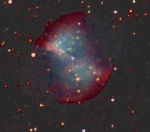 M27: The Dumbbell Nebula
29.07.1995
The Dumbbell Nebula is a beautiful red and blue planetary nebula in the constellation of Vulpecula. It is the 27th object on Charles Messier's list of diffuse sky objects, and so is referred to as M27. Its high surface brightness makes it a good target for small telescopes.
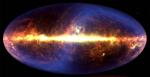 The Infrared Sky
28.01.1998
Three major sources contribute to the far-infrared sky: our Solar System, our Galaxy, and our Universe. The above image, in representative colors, is a projection of the entire infrared sky created from years of observations by the robot spacecraft COBE.
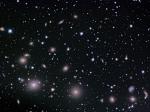 The Perseus Cluster of Galaxies
25.10.2004
Here is one of the largest objects that anyone will ever see on the sky. Each of the fuzzy blobs in the above picture is a galaxy, together making up the Perseus Cluster, one of the closest clusters of galaxies.
 A Solar System Portrait
5.05.1999
As the Voyager 1 spacecraft headed out of our Solar System, it looked back and took a parting family portrait of the Sun and planets. From beyond Pluto, our Solar System looks like a bright star surrounded by faint dots. In the above picture, the Sun is so bright it is blocked out for contrast.
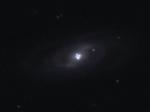 The Einstein Cross Gravitational Lens
11.03.2007
Most galaxies have a single nucleus -- does this galaxy have four? The strange answer leads astronomers to conclude that the nucleus of the surrounding galaxy is not even visible in this image. The central cloverleaf is rather light emitted from a background quasar.
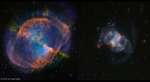 The Dumbells
17.12.2008
These two nebulae are cataloged as M27 (left) and M76, popularly known as The Dumbbell and the Little Dumbbell. Not intended to indicate substandard mental prowess, their popular names refer to their similar, dumbbell or hourglass shapes.
 Comet and Meteor
5.01.2009
This meteor streaking toward the horizon through the early morning sky of January 3rd is from the annual Quadrantid meteor shower. Aligned with the shower's radiant point high in the north (off the top of the view), the meteor trail passes to the right of bright bluish star Beta Scorpii.
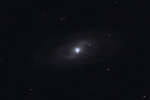 The Einstein Cross Gravitational Lens
7.02.2010
Most galaxies have a single nucleus -- does this galaxy have four? The strange answer leads astronomers to conclude that the nucleus of the surrounding galaxy is not even visible in this image. The central cloverleaf is rather light emitted from a background quasar.
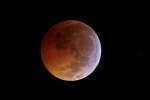 The Solstice Moon s Eclipse
23.12.2010
A big, bright, beautiful Full Moon slid into planet Earth's shadow early Tuesday morning. Remarkably, the total lunar eclipse coincided with the date of the December Solstice. During the eclipse, the best viewing...
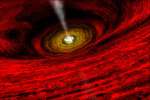 The View Near a Black Hole
23.03.2014
In the center of a swirling whirlpool of hot gas is likely a beast that has never been seen directly: a black hole. Studies of the bright light emitted by the swirling gas frequently indicate not only that a black hole is present, but also likely attributes.
|
January February March April May June July August September |
|||||||||||||||||||||||||||||||||||||||||||||||||