
|
You entered: stars
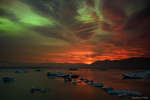 Aurora and Volcanic Light Pillar
23.09.2014
That's no sunset. And that thin red line just above it -- that's not a sun pillar. The red glow on the horizon originates from a volcanic eruption, and the red line is the eruption's reflection from fluttering atmospheric ice crystals. This unusual volcanic light pillar was captured over Iceland earlier this month.
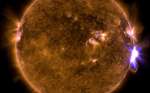 Flare Well AR2673
14.09.2017
Almost out of view from our fair planet, rotating around the Sun's western edge giant active region AR2673 lashed out with another intense solar flare followed by a large coronal mass ejection on September 10.
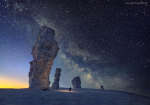 The Milky Way over the Seven Strong Men Rock Formations
3.04.2018
You may have heard of the Seven Sisters in the sky, but have you heard about the Seven Strong Men on the ground? Located just west of the Ural Mountains, the unusual Manpupuner rock formations are one of the Seven Wonders of Russia. How these ancient 40-meter high pillars formed is yet unknown.
 ISS from Wallasey
6.04.2019
After sunset on March 28, the International Space Station climbed above the western horizon, as seen from Wallasey, England at the mouth of the River Mersey. Still glinting in the sunlight some 400 kilometers...
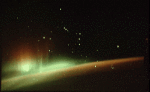 Aurora and Orion
14.11.1995
Looking toward the south from low Earth orbit, the crew of the Space Shuttle Endeavor made this stunning time exposure of the Aurora Australis (southern lights) in April of 1994. The aurora are caused by high energy electrons from the Solar Wind which are funneled into the atmosphere by the Earth's magnetic field.
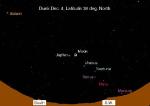 A Sky Full Of Planets
4.12.1997
Look up tonight. Just after sunset, the crescent moon and all five "naked-eye" planets (Mercury, Venus, Mars, Jupiter, and Saturn) will be visible (depending on your latitude), lying near our solar system's ecliptic plane.
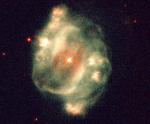 NGC 5307: A Symmetric Planetary Nebula
31.12.1997
Some stellar nebulae are strangely symmetric. For example, every major blob of gas visible on the upper left of NGC 5307 appears to have a counterpart on the lower right. This picture taken by the Hubble Space Telescope was released last week. NGC 5307 is an example of a planetary nebula with a spiral shape.
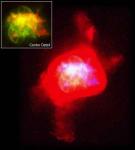 NGC 6210: The Turtle in Space Planetary Nebula
28.10.1998
A Turtle in Space? Planetary nebula NGC 6210 may look like a giant space turtle, but it is actually much more massive and violent. Fortunately, this gas cloud in Hercules lies about 6500 light years away.
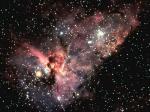 The Keyhole Nebula
23.05.1999
The dark dusty Keyhole Nebula gets its name from its unusual shape. Officially designated NGC 3324, the Keyhole Nebula is a smaller region superposed on the larger Eta Carina Nebula. These nebulae were created by the dying star Eta Carina, which is prone to violent outbursts during its final centuries.
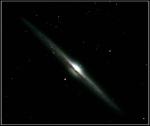 NGC 4565: Needle Galaxy
17.06.1999
Presenting a sleek needle-like profile the magnificent spiral galaxy NGC 4565 is viewed edge-on from planet Earth. Its core of stars bulges from the centre of a thin disk of spiral arms and dust. The core appears to be cut sharply by dust lanes to dramatic effect in this composite image.
|
January February March April May June July August September October |
|||||||||||||||||||||||||||||||||||||||||||||||||