
|
You entered: nearest stars
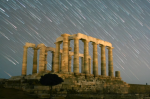 Celestial Trails over Greece
4.05.2011
If you watch the horizon at just the right place and at just the right time, you can witness some spectacular juxtapositions between Earth and sky. In the above video, stars, the Moon, and even a partially eclipsed Sun were recorded rising and setting over photogenic landmarks in Greece.
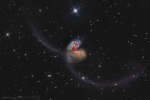 Exploring the Antennae
26.03.2021
Some 60 million light-years away in the southerly constellation Corvus, two large galaxies are colliding. Stars in the two galaxies, cataloged as NGC 4038 and NGC 4039, very rarely collide in the course of the ponderous cataclysm that lasts for hundreds of millions of years.
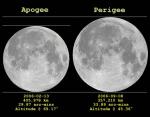 Apogee Moon, Perigee Moon
25.10.2007
Tonight, those blessed with clear skies can enjoy a glorious Full Moon, (exact full phase at 0452 UT, October 26). In fact, the Moon will reach its full phase within a few hours of perigee, the closest point in its elliptical orbit, making it the largest Full Moon of 2007.
 The Dark River to Antares
15.05.2020
A dark river seems to flow through this sky from the horizon toward colorful clouds near red giant star Antares. Murky looking, the dark river is a dusty nebula obscuring background starlight near the central Milky Way, although the dark dust nebula contains mostly hydrogen molecular gas.
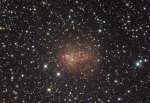 Starburst Galaxy IC 10
9.10.2009
Lurking behind dust and stars near the plane of our Milky Way Galaxy, IC 10 is a mere 2.3 million light-years distant. Its light dimmed by the intervening dust, the irregular dwarf galaxy still shows off vigorous star-forming regions that shine with a telltale reddish glow in this colorful skyscape.
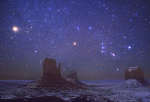 Mars and Orion over Monument Valley
2.02.2014
Welcome to The World At Night. Sharing the night sky seen around the world, this view from Monument Valley, USA includes a picturesque foreground of famous buttes. Buttes are composed of hard rock left behind after water eroded away the surrounding soft rock.
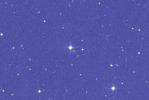 A Planet For Gliese 876
26.06.1998
Centered in this unremarkable, 1/4 degree wide patch of sky in the constellation Aquarius is the star Gliese 876. Gliese 876 is smaller than the Sun, only about 1/3 as massive, and too faint to be seen without a telescope. But it is known to be one of the nearest stars, only 15 light-years distant.
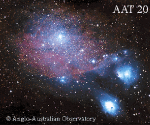 Nebulosity in Sagittarius
18.07.1996
What causes the colors in this beautiful nebulosity in Sagittarius? Dubbed NGC 6589 and NGC 6590, the colors of this nebulosity, are caused by gas and dust. The blue color of the nebula nearest the bright stars is caused by reflection off interstellar dust.
 Auroras and Star Trails over Iceland
17.05.2015
It was one of the quietest nights of aurora in weeks. Even so, in northern- Iceland during last November, faint auroras lit up the sky every clear night. The featured 360-degree panorama is the digital fusion of four wide-angle cameras each simultaneously taking 101 shots over 42 minutes.
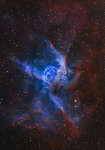 NGC 2359: Thor s Helmet
11.06.2020
NGC 2359 is a helmet-shaped cosmic cloud with wing-like appendages popularly called Thor's Helmet. Heroically sized even for a Norse god, Thor's Helmet is about 30 light-years across. In fact, the helmet...
|
January February March April May June July August September October |
|||||||||||||||||||||||||||||||||||||||||||||||||