
|
You entered: massive stars
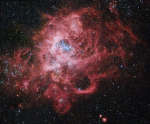 NGC 604: Giant Stellar Nursery
11.12.2012
Stars are sometimes born in the midst of chaos. About 3 million years ago in the nearby galaxy M33, a large cloud of gas spawned dense internal knots which gravitationally collapsed to form stars. NGC 604 was so large, however, it could form enough stars to make a globular cluster.
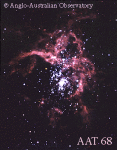 The Violent Star Cluster 30 Doradus
23.05.1996
The largest, most violent star forming region known in the whole Local Group of galaxies lies in our neighboring galaxy the LMC. Were 30 Doradus at the distance of the Orion Nebula -- a local star forming region -- it would take up fully half the sky.
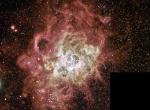 NGC 604: Giant Stellar Nursery
8.12.2003
Stars are sometimes born in the midst of chaos. About 3 million years ago in the nearby galaxy M33, a large cloud of gas spawned dense internal knots which gravitationally collapsed to form stars. NGC 604 was so large, however, it could form enough stars to make a globular cluster.
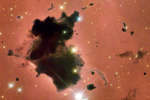 Thackerays Globules
27.12.2008
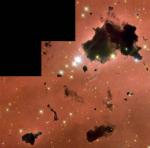
Rich star fields and glowing hydrogen gas silhouette dense, opaque clouds of interstellar gas and dust in this Hubble Space Telescope close-up of IC 2944, a bright star forming region in Centaurus, 5,900 light-years away. The largest of these dark globules, first spotted by South African astronomer A. D.
 Thackeray's Globules
7.01.2002
Rich star fields and glowing hydrogen gas silhouette dense, opaque clouds of interstellar gas and dust in this Hubble Space Telescope close-up of IC 2944, a bright star forming region in Centaurus, 5,900 light-years away. The largest of these dark globules, first spotted by South African astronomer A. D.
 APOD: 2025 June 23 Б W5: Pillars of Star Formation
22.06.2025
How do stars form? Images of the star forming region W5 like those in the infrared by NASA's Wide Field Infrared Survey Explorer (WISE, later NEOWISE) satellite provide clear clues with indications that massive stars near the center of empty cavities are older than stars near the edges.
 APOD: 2023 December 6 Б Stars Verus Dust in the Carina Nebula
5.12.2023
It's stars versus dust in the Carina Nebula and the stars are winning. More precisely, the energetic light and winds from massive newly formed stars are evaporating and dispersing the dusty stellar nurseries in which they formed.
 X Ray Portrait of Trumpler 14
2.09.2005
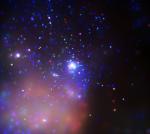
A wonder of planet Earth's southern sky, star cluster Trumpler 14 lies about nine thousand light-years away in the Carina complex -- a rich star forming region at the edge of a giant molecular cloud.
 Roses are Red
13.02.2026
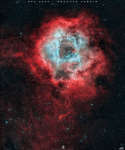
Roses are red, nebulas are too, and this Valentine's gift is a stunning view! Pictured is a loving look at the Rosette Nebula (NGC 2237): a cosmic bloom of bright young stars sitting atop a stem of glowing hot gas.
 Starburst Galaxy IC 10
4.01.2012
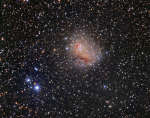
Lurking behind dust and stars near the plane of our Milky Way Galaxy, IC 10 is a mere 2.3 million light-years distant. Even though its light is dimmed by intervening dust, the irregular dwarf galaxy still shows off vigorous star-forming regions that shine with a telltale reddish glow in this colorful skyscape.
|
January February March April May |
|||||||||||||||||||||||||||||||||||||||||||||||||