
|
You entered: filament
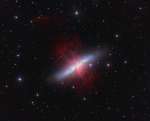 M82: Starburst Galaxy with a Superwind
4.07.2013
Also known as the Cigar Galaxy for its elongated visual appearance, M82 is a starburst galaxy with a superwind. In fact, through ensuing supernova explosions and powerful winds from massive stars, the burst of star formation in M82 is driving a prodigious outflow of material.
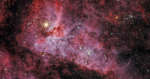 The Great Carina Nebula
27.05.2016
A jewel of the southern sky, the Great Carina Nebula, also known as NGC 3372, spans over 300 light-years, one of our galaxy's largest star forming regions. Like the smaller, more northerly Great...
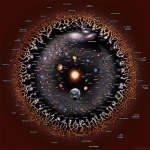 The Observable Universe
16.03.2022
How far can you see? Everything you can see, and everything you could possibly see, right now, assuming your eyes could detect all types of radiations around you -- is the observable universe. In light...
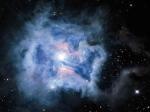 The Iris Nebula from CFHT
29.12.2005
Like delicate cosmic petals, these clouds of interstellar dust and gas have blossomed 1,300 light-years away in the fertile star fields of the constellation Cepheus. Sometimes called the Iris Nebula and dutifully cataloged as NGC 7023, this is not the only nebula in the sky to evoke the imagery of flowers.
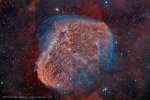 NGC 6888: The Crescent Nebula
15.09.2009
NGC 6888, also known as the Crescent Nebula, is a cosmic bubble about 25 light-years across, blown by winds from its central, bright, massive star. This beautiful portrait of the nebula is from the Isaac Newton Telescope at Roque de los Muchachos Observatory in the Canary Islands.
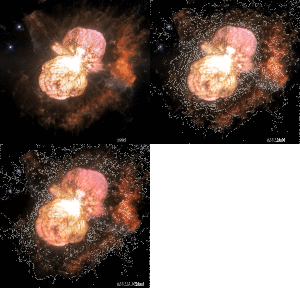 Eta Carinae and the Expanding Homunculus Nebula
1.12.2014
How did the Eta Carinae star system create this unusual expanding nebula? No one knows for sure. About 170 years ago, the southern star system Eta Carinae (Eta Car) mysteriously became the second brightest star system in the night sky. Twenty years later, after ejecting more mass than our Sun, Eta Car unexpectedly faded.
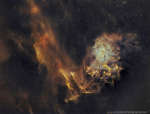 AE Aurigae and the Flaming Star Nebula
10.11.2015
Is star AE Aurigae on fire? No. Even though AE Aurigae is named the flaming star, the surrounding nebula IC 405 is named the Flaming Star Nebula, and the region appears to have the color of fire, there is no fire.
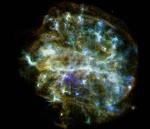 Elements in the Aftermath
26.10.2001
Massive stars spend their brief lives furiously burning nuclear fuel. Through fusion at extreme temperatures and densities surrounding the stellar core, nuclei of light elements like Hydrogen and Helium are combined to heavier elements like Carbon, Oxygen, etc. in a progression which ends with Iron.
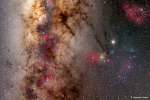 A Scorpius Sky Spectacular
7.04.2019
If Scorpius looked this good to the unaided eye, humans might remember it better. Scorpius more typically appears as a few bright stars in a well-known but rarely pointed out zodiacal constellation. To get a spectacular image like this, though, one needs a good camera, color filters, and a digital image processor.
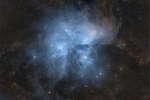 Messier 45: The Daughters of Atlas and Pleione
5.01.2023
Hurtling through a cosmic dust cloud a mere 400 light-years away, the lovely Pleiades or Seven Sisters open star cluster is well-known for its striking blue reflection nebulae. It lies in the night sky toward the constellation Taurus and the Orion Arm of our Milky Way galaxy.
|
January February March April May June July August September |
|||||||||||||||||||||||||||||||||||||||||||||||||