
|
You entered: composite image
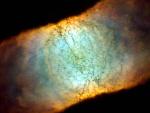 IC 4406: A Seemingly Square Nebula
18.06.2002
How can a round star make a square nebula? This conundrum comes to light when studying planetary nebulae like IC 4406. Evidence indicates that IC 4406 is likely a hollow cylinder, with its square appearance the result of our vantage point in viewing the cylinder from the side.
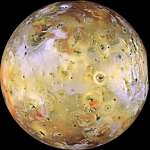 Ios Surface: Under Construction
4.08.2013
Like the downtown area of your favorite city and any self-respecting web site ... Io's surface is constantly under construction. This moon of Jupiter holds the distinction of being the Solar System's most volcanically active body -- its bizarre looking surface continuously formed and reformed by lava flows.
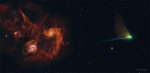 APOD: 2023 March 1 Б The Flaming Star Nebula
1.03.2023
Is star AE Aurigae on fire? No. Even though AE Aurigae is named the Flaming Star and the surrounding nebula IC 405 is named the Flaming Star Nebula, and even though the nebula appears to some like a swirling flame, there is no fire.
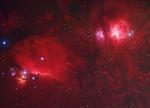 An Orion Deep Field
15.01.2004
Adrift 1,500 light-years away in one of the night sky's most recognizable constellations, the glowing Orion Nebula and the dark Horsehead Nebula are contrasting cosmic vistas. They both appear in this stunning composite digital image assembled from over 20 hours of data that includes exposures filtered to record emission from hydrogen atoms.
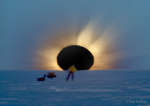 A Total Eclipse at the End of the World
14.03.2015
Would you go to the end of the world to see a total eclipse of the Sun? If you did, would you be surprised to find someone else there already? In 2003, the Sun, the Moon, Antarctica, and two photographers all lined up in Antarctica during an unusual total solar eclipse.
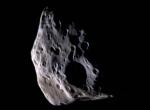 Small Moon Epimetheus
29.04.2005
Small saturnian moon Epimetheus (ep-ee-MEE-thee-us) is at most 116 kilometers across. Its cratered surface and irregular shape are highlighted by dramatic shadows in this composite close-up image from the Cassini spacecraft. However, orbiting 91,000 kilometers above Saturn's cloud tops, Epimetheus is not alone.
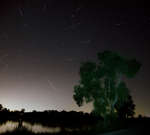 Perseid Meteors Over Ontario
13.08.2013
Where are all of these meteors coming from? In terms of direction on the sky, the pointed answer is the constellation of Perseus. That is why the meteor shower that peaked over the past few days is known as the Perseids -- the meteors all appear to come from a radiant toward Perseus.
 APOD: 2024 May 13 Б AR 3664 on a Setting Sun
13.05.2024
It was larger than the Earth. It was so big you could actually see it on the Sun's surface without magnification. It contained powerful and tangled magnetic fields as well as numerous dark sunspots.
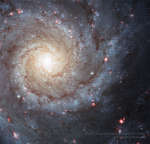 APOD: 2026 August 30 Б M74: A Grand Design Spiral
30.08.2026
If not the most grand, then this spiral galaxy is at least one of the most photogenic. An island universe of about 100 billion stars, 32 million light-years away toward the constellation Pisces, M74 presents a gorgeous face-on view.
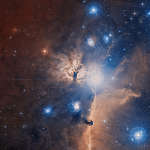 Inside the Flame Nebula
10.05.2014
The Flame Nebula stands out in this optical image of the dusty, crowded star forming regions toward Orion's belt, a mere 1,400 light-years away. X-ray data from the Chandra Observatory and infrared images from the Spitzer Space Telescope can take you inside the glowing gas and obscuring dust clouds though.
|
January February March April May June July August September |
|||||||||||||||||||||||||||||||||||||||||||||||||