
|
You entered: all sky
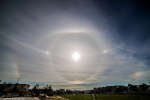 Ice Halos at Yellowknife
14.09.2018
You've probably seen a circle around the Sun before. More common than rainbows, ice halos, like a 22 degree circular halo for example, can be easy to spot, especially if you can shade your eyes from direct sunlight.
 The Leo Trio
21.03.2024
This popular group leaps into the early evening sky around the March equinox and the northern hemisphere spring. Famous as the Leo Triplet, the three magnificent galaxies found in the prominent constellation Leo gather here in one astronomical field of view.
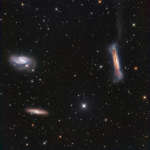 The Leo Trio
20.03.2021
This popular group leaps into the early evening sky around the March equinox and the northern hemisphere spring. Famous as the Leo Triplet, the three magnificent galaxies found in the prominent constellation Leo gather here in one astronomical field of view.
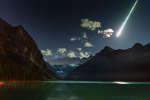 Fireball over Lake Louise
12.10.2021
What makes a meteor a fireball? First of all, everyone agrees that a fireball is an exceptionally bright meteor. Past that, the International Astronomical Union defines a fireball as a meteor brighter than apparent magnitude -4, which corresponds (roughly) to being brighter than any planet -- as well as bright enough to cast a human-noticeable shadow.
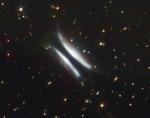 Gomezs Hamburger: A Proto Planetary Nebula
7.08.2002
What, in heaven, is that? Sometimes astronomers see things on the sky they don't immediately understand. In 1985 this happened to Arturo Gomez, and the object became known as Gomez's Hamburger for its distinctive yet familiar shape.
 Eta Car: 3D Model of the Most Dangerous Star Known
9.02.2022
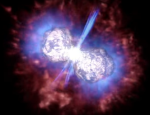
What's the most dangerous star near earth? Many believe it's Eta Carinae, a binary star system about 100 times the mass of the Sun, just 10,000 light years from earth.
 NGC 7789: Caroline s Rose
6.07.2024
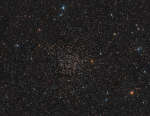
Found among the rich starfields of the Milky Way, star cluster NGC 7789 lies about 8,000 light-years away toward the constellation Cassiopeia. A late 18th century deep sky discovery of astronomer Caroline Lucretia Herschel, the cluster is also known as Caroline's Rose.
 A Milky Way Band
5.06.2005
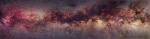
Most bright stars in our Milky Way Galaxy reside in a disk. Since our Sun also resides in this disk, these stars appear to us as a diffuse band that circles the sky.
 A Milky Way Band
30.09.2007
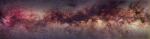
Most bright stars in our Milky Way Galaxy reside in a disk. Since our Sun also resides in this disk, these stars appear to us as a diffuse band that circles the sky.
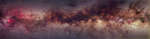 A Milky Way Band
10.07.2011
Most bright stars in our Milky Way Galaxy reside in a disk. Since our Sun also resides in this disk, these stars appear to us as a diffuse band that circles the sky.
|
January February March April May June July August September |
|||||||||||||||||||||||||||||||||||||||||||||||||