
|
You entered: Earth orbit
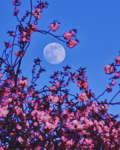 Pink and the Perigee Moon
30.04.2021
On April 25 a nearly full moon rose just before sunset. Welcomed in a clear blue sky and framed by cherry blossoms, its familiar face was captured in this snapshot from Leith, Edinburgh, Scotland. Known to some as a Pink Moon, April's full lunar phase occurred with the moon near perigee.
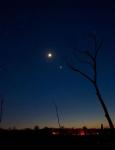 A Western Sky at Twilight
1.05.2004
On April 23rd, the Moon along with planets Saturn, Mars, and Venus (and planet Earth of course ...) were all visible in the west at twilight, captured here from a site near Saylorvillle Lake north of Des Moines, Iowa, USA.
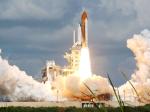 America Returns to Space Flight
27.07.2005
NASA's launch of the massive Space Shuttle Discovery yesterday brought a nation known for its tremendous space program back to human space flight. Shuttle flights had been suspended for over two years previously following the tragic loss of the Space Shuttle Columbia crew on 2003 February 1.
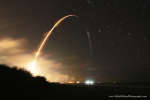 A Launch and a Landing
27.09.2014
Taken from an Atlantic beach, Cape Canaveral, planet Earth, four identically framed digital images are combined in this night skyscape. Slightly shifted short star trails dot the sky, but the exposure times were adjusted to follow the flight of a Falcon 9 rocket.
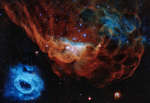 Hubble s Cosmic Reef
25.04.2020
These bright ridges of interstellar gas and dust are bathed in energetic starlight. With its sea of young stars, the massive star-forming region NGC 2014 has been dubbed the Cosmic Reef. Drifting just...
 Retrograde Mars
13.06.2010
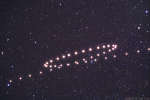
Why would Mars appear to move backwards? Most of the time, the apparent motion of Mars in Earth's sky is in one direction, slow but steady in front of the far distant stars. About every two years, however, the Earth passes Mars as they orbit around the Sun.
 A RADARSAT Map of Antarctica
16.11.1999
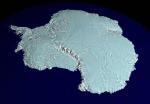
It's not easy to make a map of Antarctica. Earth's southern most continent is so cold and inhospitable that much of it remains unexplored. From space, though, it is possible to map this entire region by radar: by systematically noting how long it takes for radio waves to reflect off the terrain.
 Iridium 52: Not A Meteor
22.10.1999
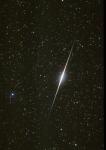
While hunting for meteors in the night sky above the White Mountains near Bishop, California, astrophotographer James Young instead captured this brilliant celestial apparition. Recorded near twilight on August 13, the bright streak is not the flash of a meteor trail but sunlight glinting from a satellite.
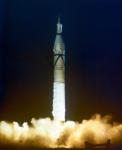 The First Explorer
12.08.2006
Inaugurating the era of space exploration for the US, the First Explorer, a thirty pound satellite, was launched into Earth orbit on February 1, 1958 by the Army Ballistic Missle Agency. Explorer I carried instruments to measure temperatures, micrometeorite impacts, and an experiment designed by James A.
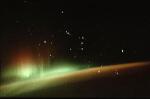 Aurora and Orion
26.01.1997
Looking toward the south from low Earth orbit, the crew of the Space Shuttle Endeavor made this stunning time exposure of the Aurora Australis or southern lights in April of 1994. Aurora are visible at high northern latitudes as well, with the northern lights known as Aurora Borealis.
|
January February March April May June July August September October |
|||||||||||||||||||||||||||||||||||||||||||||||||