
|
You entered: Earth
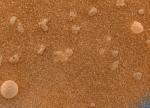 Magnified Mars
6.02.2004
At first glance, this sharp, color close-up gives the strong impression of pebbles strewn over a sandy beach. But the picture is one of the first microscopic images of another planet, captured by the Opportunity rover on its tenth sol on the martian surface at Meridiani Planum.
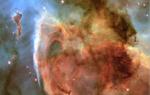 Colorful Clouds Of Carina
3.02.2000
Tumultuous clouds of the Carina Nebula, 8000 light-years away, glow in planet Earth's southern sky. Striking and detailed, this close-up of a portion of the famous nebula is a combination of exposures through six different filters taken with the Hubble Space Telescope's Wide Field Planetary Camera 2 in April of 1999.
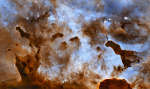 Dark Clouds of the Carina Nebula
19.09.2010
What dark forms lurk in the mists of the Carina Nebula? These ominous figures are actually molecular clouds, knots of molecular gas and dust so thick they have become opaque. In comparison, however, these clouds are typically much less dense than Earth's atmosphere.
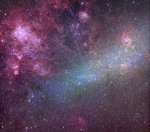 The Large Cloud of Magellan
16.10.2010
The 16th century Portuguese navigator Ferdinand Magellan and his crew had plenty of time to study the southern sky during the first circumnavigation of planet Earth. As a result, two fuzzy cloud-like objects easily...
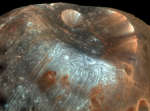 Stickney Crater
18.01.2013
Stickney Crater, the largest crater on the martian moon Phobos, is named for Chloe Angeline Stickney Hall, mathematician and wife of astronomer Asaph Hall. Asaph Hall discovered both the Red Planet's moons in 1877.
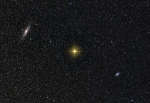 M31 versus M33
26.09.2015
Separated by about 14 degrees (28 Full Moons) in planet Earth's sky, spiral galaxies M31 at left, and M33 are both large members of the Local Group, along with our own Milky Way galaxy.
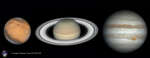 Three Planets from Pic du Midi
2.06.2016
Seen any planets lately? All three planets now shining brightly in the night sky are imaged in these panels, captured last week with the 1 meter telescope at Pic du Midi Observatory in the French Pyrenees.
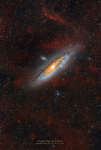 Clouds of Andromeda
4.01.2017
The beautiful Andromeda Galaxy is often imaged by planet Earth-based astronomers. Also known as M31, the nearest large spiral galaxy is a familiar sight with dark dust lanes, bright yellowish core, and spiral arms traced by blue starlight.
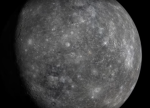 Mercury Visualized from MESSENGER
11.12.2017
What would it be like to fly over the planet Mercury? Images and data taken from NASA's robotic MESSENGER spacecraft that orbited Mercury from 2011 to 2015 have been digitally combined to envision a virtual flight that highlights much of the hot planet's surface.
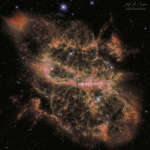 APOD: 2020 August 14 Б NGC 5189: An Unusually Complex Planetary Nebula
14.08.2020
Why is this nebula so complex? When a star like our Sun is dying, it will cast off its outer layers, usually into a simple overall shape. Sometimes this shape is a sphere, sometimes a double lobe, and sometimes a ring or a helix.
|
January February March April May June July August September October |
|||||||||||||||||||||||||||||||||||||||||||||||||