
|
You entered: stars
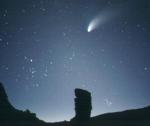 Help Aldebaran Map the Moon
28.07.1997
Turn on your camcorder, go outside, and become an astronomer. How?. Tomorrow morning, our Moon will pass directly in front of Aldebaran, the brightest star in this picture and in entire constellation of Taurus.
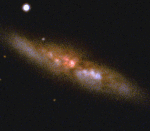 M82: An Irregular Galaxy
28.07.1995
Not all galaxies have spiral structure like our Milky Way. Many have smooth elliptical shapes, but also many have irregular shapes such as the bright sky object M82, the 82nd object on Messier's list.
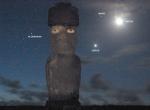 Planets Over Easter Island
24.05.2004
It isn't every day that planets line up behind a stone giant. For one thing, it helps to have a good planet line-up, such as occurred in the sky just last month. For another, it helps to be on Easter Island, where over 800 large stone statues exist.
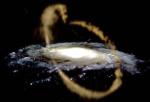 The Sagittarius Dwarf Tidal Stream
29.05.2005
Is our Milky Way Galaxy out to lunch? Recent wide field images and analyses now indicate that our home galaxy is actually still in the process of devouring one of its closer satellite neighbors.
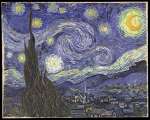 Starry Night by Vincent van Gogh
11.10.2009
The painting Starry Night is one of the most famous icons of the night sky ever created. The scene was painted by Vincent van Gogh in southern France in 1889. The swirling style of Starry Night appears, to many, to make the night sky come alive.
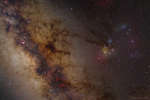 A Wide Field Image of the Galactic Center
6.01.2012
From Sagittarius to Scorpius, the central Milky Way is a truly beautiful part of planet Earth's night sky. The gorgeous region is captured in this wide field image spanning about 30 degrees.
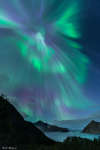 Auroral Corona over Norway
14.10.2014
Higher than the highest mountain lies the realm of the aurora. Auroras rarely reach below 60 kilometers, and can range up to 1000 kilometers. Aurora light results from energetic electrons and protons striking atoms and molecules in the Earth's atmosphere.
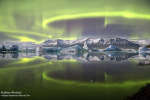 Aurora over Icelandic Glacier
9.03.2015
Several key conditions came together to create this award-winning shot. These included a dark night, few clouds, an epic auroral display, and a body of water that was both calm enough and unfrozen enough to show reflected stars.
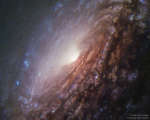 In the Center of Spiral Galaxy NGC 5033
9.01.2017
What's happening in the center of spiral NGC 5033? Many things -- some circular, some energetic, and some not well understood. NGC 5033 is known as a Seyfert galaxy because of the great activity seen in its nucleus.
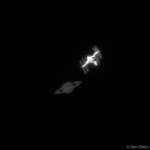 Saturn and ISS
9.07.2022
Soaring high in skies around planet Earth, bright planet Saturn was a star of June's morning planet parade. But very briefly on June 24 it posed with a bright object in low Earth orbit, the International Space Station.
|
January February March April May June July August September October |
|||||||||||||||||||||||||||||||||||||||||||||||||