
|
You entered: young stars
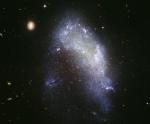 NGC 1427A: Galaxy in Motion
4.03.2005
In this tantalizing image, young blue star clusters and pink star-forming regions abound in NGC 1427A, a galaxy in motion. The small irregular galaxy's swept back outline points toward the top of this...
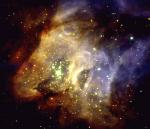 Star Forming Region RCW38
7.12.1998
Star cluster RCW38 was hiding. This open cluster of stars is located about 5000 light years away towards the constellation of Vela. Looking there will not normally reveal most of the stars in this cluster, though.
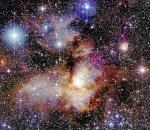 Star-Forming Region RCW38 from 2MASS
17.07.2002
The star cluster in RCW38 was hiding. Looking at the star forming region RCW38 will not normally reveal most of the stars in this cluster. The reason is that the open cluster is so young that it is still shrouded in thick dust that absorbs visible light.
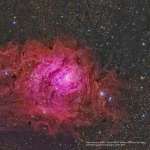 Pan STARRS Across the Lagoon
25.04.2019
Ridges of glowing interstellar gas and dark dust clouds inhabit the turbulent, cosmic depths of the Lagoon Nebula. Also known as M8, the bright star forming region is about 5,000 light-years distant.
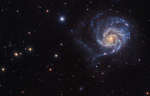 A View Toward M101
20.05.2017
Big, beautiful spiral galaxy M101 is one of the last entries in Charles Messier's famous catalog, but definitely not one of the least. About 170,000 light-years across, this galaxy is enormous, almost twice the size of our own Milky Way galaxy.
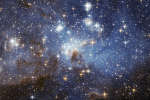 Star Forming Region LH 95
12.03.2008
How do stars form? To better understand this complex and chaotic process, astronomers used the Hubble Space Telescope to image in unprecedented detail the star forming region LH 95 in the nearby Large Magellanic Cloud galaxy.
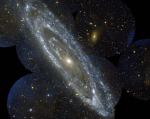 The Andromeda Galaxy from GALEX
22.12.2003
Why does the Andromeda Galaxy have a giant ring? Viewed in ultraviolet light, the closet major galaxy to our Milky Way Galaxy looks more like a ring galaxy than a spiral. The ring...
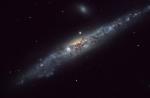 NGC 4631: The Whale Galaxy
29.03.2002
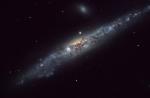
NGC 4631 is a big beautiful spiral galaxy seen edge-on only 25 million light-years away towards the small northern constellation Canes Venatici. This galaxy's slightly distorted wedge shape suggests to some a cosmic herring and to others the popular moniker of The Whale Galaxy.
 NGC 4631: The Whale Galaxy
23.01.2004
NGC 4631 is a big beautiful spiral galaxy seen edge-on only 25 million light-years away towards the small northern constellation Canes Venatici. This galaxy's slightly distorted wedge shape suggests to some a cosmic herring and to others the popular moniker of The Whale Galaxy.
 Protostellar Outflows in Serpens
27.06.2024
Jets of material blasting from newborn stars, are captured in this James Webb Space Telescope close-up of the Serpens Nebula. The powerful protostellar outflows are bipolar, twin jets spewing in opposite directions. Their directions are perpendicular to accretion disks formed around the spinning, collapsing stellar infants.
|
January February March April May June July August September |
|||||||||||||||||||||||||||||||||||||||||||||||||