
|
You entered: face
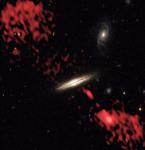 192: The Wrong Galaxy
13.01.2003
Centered above is distant galaxy 0313-192, some one billion light-years away. Radio emission from the galaxy has been mapped by the National Radio Astronomy Observatory's Very Large Array and is shown in red, composited with a visible light image from the Hubble Space Telescope's new Advanced Camera for Surveys.
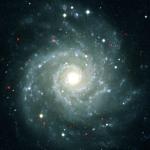 ULXs in M74
30.03.2005
In visual appearance, M74 is a nearly perfect face-on spiral galaxy, about 30 million light-years away toward the constellation Pisces. The red blotches seen in this composite view are ultraluminous x-ray sources (ULXs) mapped by the Chandra X-ray Observatory.
 A Picturesque Venus Transit
3.06.2012
The rare transit of Venus across the face of the Sun in 2004 was one of the better-photographed events in sky history. Both scientific and artistic images flooded in from the areas that could see the transit: Europe and much of Asia, Africa, and North America.
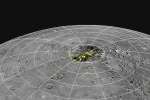 Northern Mercury
1.12.2012
Innermost planet Mercury would probably not be a good location for an interplanetary winter olympics. But new results based on data from the Mercury orbiting MESSENGER spacecraft indicate that it does have substantial water ice in permanently shadowed regions within craters near its north pole.
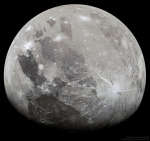 Ganymede from Juno
13.06.2021
What does the largest moon in the Solar System look like? Jupiter's moon Ganymede, larger than even Mercury and Pluto, has an icy surface speckled with bright young craters overlying a mixture of older, darker, more cratered terrain laced with grooves and ridges.
 Titania's Trenches
10.01.1997
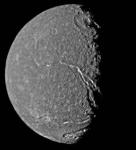
British astronomer Sir William Herschel discovered Titania and Oberon in 1787, 210 years ago today. He wasn't reading Shakespeare's A Midsummer Night's Dream though, he was making the first telescopic observations of moons of the planet Uranus (a planet which he himself discovered in 1781).
 Fireworks Galaxy NGC 6946
31.12.2010
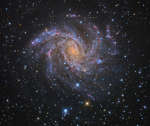
Celebrate the New Year with the Fireworks Galaxy! Also known as NGC 6946, the big, beautiful spiral galaxy is located just 10 million light-years away, behind a veil of foreground dust and stars in the high and far-off constellation of Cepheus. From our vantage point in the Milky Way Galaxy, we see NGC 6946 face-on.
 Cetus Galaxies and Supernova
5.12.2018
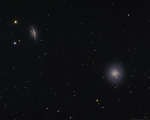
Large spiral galaxy NGC 1055 at top left joins spiral Messier 77 (bottom right) in this cosmic view toward the aquatic constellation Cetus. The narrowed, dusty appearance of edge-on spiral NGC 1055 contrasts nicely with the face-on view of M77's bright nucleus and spiral arms.
 Ice Moon Tethys from Saturn Orbiting Cassini
7.12.2009
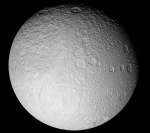
What processes formed the unusual surface of Saturn's moon Tethys? To help find out, NASA sent the robotic Cassini spacecraft right past the enigmatic ice moon in 2005. Pictured above is one of the highest resolution images of an entire face of Tethys yet created.
 M57: The Ring Nebula
16.04.2018
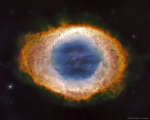
Except for the rings of Saturn, the Ring Nebula (M57) is probably the most famous celestial band. Its classic appearance is understood to be due to our own perspective, though. The recent mapping...
|
January February |
|||||||||||||||||||||||||||||||||||||||||||||||||