
|
You entered: explosion
 Spiral Galaxy NGC 2841
23.03.2023
A mere 46 million light-years distant, spiral galaxy NGC 2841 can be found in planet Earth's night sky toward the northern constellation of Ursa Major. This sharp image centered on the gorgeous island universe also captures spiky foreground Milky Way stars and more distant background galaxies within the same telescopic field of view.
 APOD: 2023 April 24 Б The Medulla Nebula Supernova Remnant
24.04.2023
What powers this unusual nebula? CTB-1 is the expanding gas shell that was left when a massive star toward the constellation of Cassiopeia exploded about 10,000 years ago. The star likely detonated when it ran out of elements near its core that could create stabilizing pressure with nuclear fusion.
 APOD: 2024 August 18 Б A Solar Prominence Eruption from SDO
18.08.2024
One of the most spectacular solar sights is an erupting prominence. In 2011, NASA's Sun-orbiting Solar Dynamic Observatory spacecraft imaged an impressively large prominence erupting from the surface. The dramatic explosion was captured in ultraviolet light in the featured time lapse video covering 90 minutes, where a new frame was taken every 24 seconds.
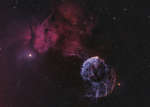 Sharpless 249 and the Jellyfish Nebula
27.02.2026
Normally faint and elusive, the Jellyfish Nebula is caught in this alluring telescopic field of view. Floating in the interstellar sea, the nebula is anchored right and left by two bright stars, Mu and Eta Geminorum, at the foot of the celestial twins.
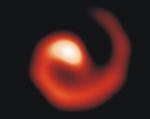 WR 104: Pinwheel Star
9.04.1999
Like a cosmic lawn sprinkler, dust streaming from a rotating star system creates a pinwheel pattern in this false color infrared image. Astronomers discovered the surprising star dust scenario using a sophisticated interferometer and the 10 meter Keck I telescope to observe the bright Wolf-Rayet star WR 104.
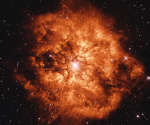 Wolf Rayet Star 124: Stellar Wind Machine
1.07.2014
Some stars explode in slow motion. Rare, massive Wolf-Rayet stars are so tumultuous and hot that they slowly disintegrating right before our telescopes. Glowing gas globs each typically over 30 times more massive than the Earth are being expelled by violent stellar winds.
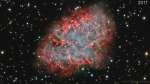 M1: The Incredible Expanding Crab Nebula
19.01.2020
Are your eyes good enough to see the Crab Nebula expand? The Crab Nebula is cataloged as M1, the first on Charles Messier's famous list of things which are not comets. In fact...
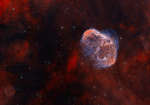 Cygnus: Bubble and Crescent
17.10.2020
These clouds of gas and dust drift through rich star fields along the plane of our Milky Way Galaxy toward the high flying constellation Cygnus. Caught within the telescopic field of view are the Soap Bubble (lower left) and the Crescent Nebula (upper right).
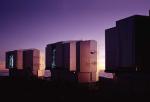 The VLT Interferometric Array
9.03.1999
The Very Large Telescope (VLT) Interferometric Array will be able to act as individual telescopes or as one huge telescope. Of the four planned VLTs in Chile, two have now reached completion. The first VLT to operate is visible on the left of the above photograph and was recently given the name Antu.
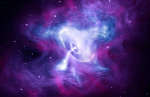 The Crab from Space
17.03.2018
The Crab Nebula is cataloged as M1, the first object on Charles Messier's famous list of things which are not comets. In fact, the Crab is now known to be a supernova remnant, expanding debris from the death explosion of a massive star.
|
January February March April May June July August |
||||||||||||||||||||||||||||||||||||||||||||||||||||||||