
|
You entered: dust cloud
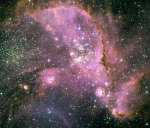 Young Stars of NGC 346
12.05.2022
The massive stars of NGC 346 are short lived, but very energetic. The star cluster is embedded in the largest star forming region in the Small Magellanic Cloud, some 210,000 light-years distant. Their...
 APOD: 2025 April 28 Б Gum 37 and the Southern Tadpoles
28.04.2025
This cosmic skyscape features glowing gas and dark dust clouds alongside the young stars of NGC 3572. A beautiful emission nebula and star cluster, it sails far southern skies within the nautical constellation Carina.
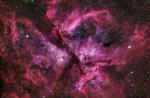 The Great Carina Nebula
27.10.2007
A jewel of the southern sky, the Great Carina Nebula, aka NGC 3372, spans over 300 light-years, one of our galaxy's largest star forming regions. Like the smaller, more northerly Orion Nebula...
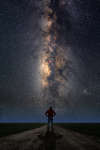 The Milky Road
13.06.2009
Inspired by the night skies of planet Earth in the International Year of Astronomy, photographer Larry Landolfi created this tantalizing fantasy view. The composited image suggests a luminous Milky Way is the heavenly extension of a country road.
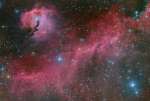 The Seagull Nebula
29.08.2015
A broad expanse of glowing gas and dust presents a bird-like visage to astronomers from planet Earth, suggesting its popular moniker - The Seagull Nebula. This portrait of the cosmic bird covers a 1.6 degree wide swath across the plane of the Milky Way, near the direction of Sirius, alpha star of the constellation Canis Major.
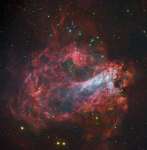 Star Factory Messier 17
18.04.2013
Sculpted by stellar winds and radiation, the star factory known as Messier 17 lies some 5,500 light-years away in the nebula-rich constellation Sagittarius. At that distance, this degree wide field of view spans almost 100 light-years.
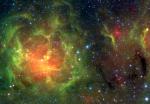 Infrared Trifid
13.01.2005
The Trifid Nebula, aka M20, is easy to find with a small telescope, a well known stop in the nebula rich constellation Sagittarius. But where visible light pictures show the nebula divided into three parts by dark, obscuring dust lanes, this penetrating infrared image reveals filaments of luminous gas and newborn stars.
 The M81 Galaxy Group Through the Integrated Flux Nebula
12.05.2008
Large galaxies and faint nebula highlight this deep image of the M81 Group of galaxies. First and foremost in the above wide-angle 12-hour exposure is the grand design spiral galaxy M81, the largest galaxy visible in the image.
 The Great Carina Nebula
19.04.2024
A jewel of the southern sky, the Great Carina Nebula is more modestly known as NGC 3372. One of our Galaxy's largest star forming regions, it spans over 300 light-years. Like the smaller, more northerly Great Orion Nebula, the Carina Nebula is easily visible to the unaided eye.
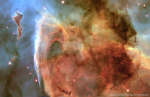 The Keyhole in the Carina Nebula
14.08.2016
The dark dusty Keyhole Nebula gets its name from its unusual shape. The looping Keyhole, in this featured classic image by the Hubble Space Telescope, is a smaller region inside the larger Carina Nebula.
|
January February March April May June July August September |
|||||||||||||||||||||||||||||||||||||||||||||||||