
|
You entered: composite image
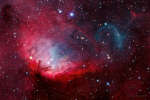 The Tulip and Cygnus X 1
15.02.2017
Framing a bright emission region, this telescopic view looks out along the plane of our Milky Way Galaxy toward the nebula rich constellation Cygnus the Swan. Popularly called the Tulip Nebula, the reddish glowing cloud of interstellar gas and dust is also found in the 1959 catalog by astronomer Stewart Sharpless as Sh2-101.
 APOD: 2024 September 25 Б Comet A3 Through an Australian Sunrise
24.09.2024
Comet Tsuchinshan-ATLAS is now visible in the early morning sky. Diving into the inner Solar System at an odd angle, this large dirty iceberg will pass its closest to the Sun -- between the orbits of Mercury and Venus -- in just two days.
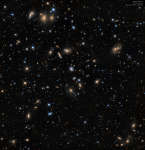 The Hercules Cluster of Galaxies
6.11.2020
These are galaxies of the Hercules Cluster, an archipelago of island universes a mere 500 million light-years away. Also known as Abell 2151, this cluster is loaded with gas and dust rich, star-forming spiral galaxies but has relatively few elliptical galaxies, which lack gas and dust and the associated newborn stars.
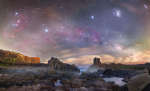 From Orion to the Southern Cross
17.01.2022
This is a sky filled with glowing icons. On the far left is the familiar constellation of Orion, divided by its iconic three-aligned belt stars and featuring the famous Orion Nebula, both partly encircled by Barnard's Loop. Just left of center in the featured image is the brightest star in the night: Sirius.
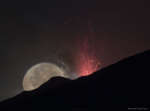 Moon behind Lava Fountain
3.09.2018
What's happened to the Moon? Nothing, but something has happened to the image of the Moon. The heat from a volcanic lava fountain in the foreground has warmed and made turbulent the air nearby, causing passing light to refract differently than usual.
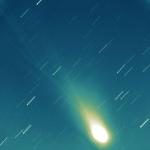 Tails Of Comet LINEAR
27.07.2000
Comet C/1999 S4 LINEAR is only one of many comets discovered with the Lincoln Near Earth Asteroid Research (LINEAR) telescope operating near Soccoro, New Mexico, USA. Traveling steadily southward through Earth's night...
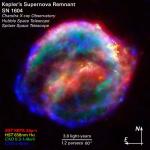 Kepler s SNR from Chandra, Hubble, Spitzer
8.10.2004
Light from the stellar explosion that created this energized cosmic cloud was first seen on planet Earth in October 1604, a mere four hundred years ago. The supernova produced a bright new star in early 17th century skies within the constellation Ophiucus.
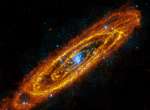 The Once and Future Stars of Andromeda
19.01.2011
The big, beautiful Andromeda Galaxy, aka M31, is a spiral galaxy a mere 2.5 million light-years away. Two space-based observatories have combined to produce this intriguing composite image of Andromeda, at wavelengths outside the visible spectrum. The remarkable view follows the locations of this galaxy's once and future stars.
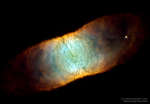 IC 4406: A Seemingly Square Nebula
7.01.2017
How can a round star make a square nebula? This conundrum comes to light when studying planetary nebulae like IC 4406. Evidence indicates that IC 4406 is likely a hollow cylinder, with its square appearance the result of our vantage point in viewing the cylinder from the side.
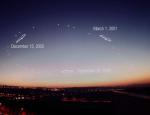 Venus Evening Loop
1.06.2001
From September 2000 through March 2001, astronomer Tunc Tezel patiently photographed the planet Venus on 25 different dates as it wandered through the evening twilight. The pictures were taken from the same spot...
|
January February March April May June July August September |
|||||||||||||||||||||||||||||||||||||||||||||||||