
|
You entered: Earth orbit
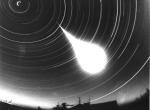 On The Trail Of A Fireball
19.02.1999
This exceptionally bright fireball meteor trail was photographed with a fish-eye camera at a Czech Republic station of the European Fireball Network on January 21, 1999. Of the star trails visible in this night-long exposure, the bright short arc in the upper left is due to Polaris, the north star.
 Circling the Sun
13.01.2024
Earth's orbit around the Sun is not a circle, it's an ellipse. The point along its elliptical orbit where our fair planet is closest to the Sun is called perihelion. This year...
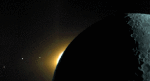 The Ecliptic Plane
14.10.2000
The Plane of the Ecliptic is well illustrated in this picture from the 1994 lunar prospecting Clementine spacecraft. Clementine's star tracker camera image reveals (from right to left) the Moon lit by Earthshine, the Sun's corona rising over the Moon's dark limb, and the planets Saturn, Mars, and Mercury.
 Lunation
5.02.2012
Our Moon's appearance changes nightly. This time-lapse sequence shows what our Moon looks like during a lunation, a complete lunar cycle. As the Moon orbits the Earth, the half illuminated by the Sun first becomes increasingly visible, then decreasingly visible. The Moon always keeps the same face toward the Earth.
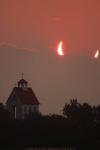 Clouds and the Moon Move to Block the Sun
18.06.2003
High above a small church near Vienna, Austria, clouds and the Moon vied for position in front of the Sun. Such was the case on the ground late last month during a partial eclipse of the Sun visible throughout Europe and Asia.
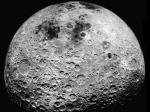 The Far Side of the Moon
25.02.2007
Does this moon look familiar? Possibly not, even though it is Earth's Moon. Locked in synchronous rotation, the Moon always presents its well-known near side to Earth. But from lunar orbit, Apollo astronauts also grew to know the Moon's far side.
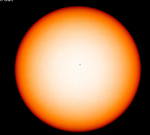 Mercury Crosses a Quiet Sun
2.12.2019
What's that black dot crossing the Sun? The planet Mercury. Mercury usually passes over or under the Sun, as seen from Earth, but last month the Solar System's innermost planet appeared to go just about straight across the middle.
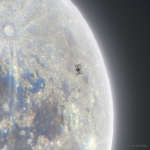 Space Station Silhouette on the Moon
6.12.2021
What's that unusual spot on the Moon? It's the International Space Station. Using precise timing, the Earth-orbiting space platform was photographed in front of a partially lit gibbous Moon last month.
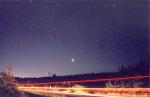 A July Dawn
7.08.2001
Those up before dawn in late July in the northern hemisphere could see planets, stars, and a spacecraft in a single quick glance before starting their day. Near the eastern horizon was bright Jupiter, and not far above and to its right was the very bright Venus.
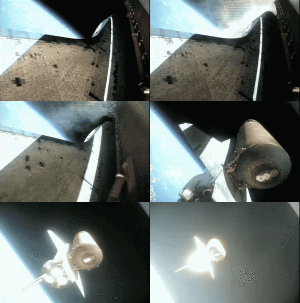 A Space Shuttle Climbs to Orbit
13.07.2006
You are going into space. New small cameras allow anyone with a web browser to virtually ride along with the space shuttle, at times from numerous angles, as it launches into Earth orbit. Small...
|
January February March April May June July August September October |
|||||||||||||||||||||||||||||||||||||||||||||||||