
|
You entered: Earth
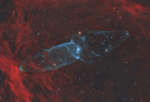 Ou4: The Giant Squid Nebula
12.10.2022
A mysterious squid-like cosmic cloud, this nebula is very faint, but also very large in planet Earth's sky. In the image, composed with 30 hours of narrowband image data, it spans nearly three full moons toward the royal constellation Cepheus.
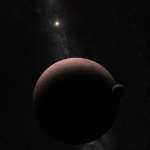 Moon over Makemake
31.12.2022
Makemake (sounds like MAH-kay MAH-kay), second brightest dwarf planet of the Kuiper belt, has a moon. Nicknamed MK2, Makemake's moon reflects sunlight with a charcoal-dark surface, about 1,300 times fainter than its parent body.
 M100: A Grand Design Spiral Galaxy
2.05.2024
Majestic on a truly cosmic scale, M100 is appropriately known as a grand design spiral galaxy. The large galaxy of over 100 billion stars has well-defined spiral arms, similar to our own Milky Way.
 APOD: 2025 January 26 Б The Many Tails of Comet G3 ATLAS
26.01.2025
Why does this comet have so many tails? C/2024 G3 (ATLAS) has developed several long and intricate tails visible from Earth's southern hemisphere over the past two weeks. Many observers reported seeing the impressive comet without any optical aid above the western horizon just after sunset.
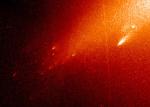 Comet LINEAR Disperses
8.08.2000
What's happened to the nucleus of Comet LINEAR? The brightest comet this year has unexpectedly broken up into many smaller pieces. The break-up occurred on or about July 25 and was noted by many astronomers around the world with particularly pioneering work by Mark Kidger (IAC).
 Solar System Portrait
14.02.2002
On another Valentine's Day (February 14, 1990), cruising four billion miles from the Sun, the Voyager 1 spacecraft looked back to make this first ever family portrait of our Solar System. The complete portrait is a 60 frame mosaic made from a vantage point 32 degrees above the ecliptic plane.
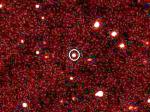 Solar System Object Larger than Pluto Discovered
31.07.2005
Is that a tenth planet? A faint, slowly moving dot discovered by computer shows clear signs of being a deep Solar System object at least as large as Pluto. The object, designated 2003 UB 313 , is currently situated nearly 100 times the Earth-Sun distance -- over twice the average Pluto-Sun distance.
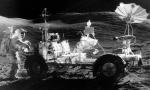 Apollo 17's Lunar Rover
1.07.1999
In December of 1972, Apollo 17 astronauts Eugene Cernan and Harrison Schmitt spent about 75 hours exploring the Moon's Taurus-Littrow valley while colleague Ronald Evans orbited overhead. Cernan and Schmitt were the last humans to walk or ride on the Moon - aided in their explorations by a Lunar Roving Vehicle.
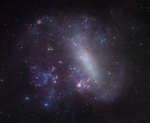 The Large Cloud of Magellan
19.12.2008
The 16th century Portuguese navigator Ferdinand Magellan and his crew had plenty of time to study the southern sky during the first circumnavigation of planet Earth. As a result, two fuzzy cloud-like objects easily...
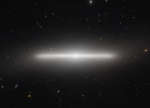 NGC 4452: An Extremely Thin Galaxy
9.11.2010
Why is there a line segment on the sky? In one of the more precise alignments known in the universe, what is pictured above is actually a disk galaxy being seen almost perfectly edge on. The image from the Hubble Space Telescope is a spectacular visual reminder of just how thin disk galaxies can be.
|
January February March April May June July August September October |
|||||||||||||||||||||||||||||||||||||||||||||||||