
|
You entered: space station
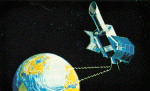 The International Ultraviolet Explorer
28.09.1995
The International Ultraviolet Explorer (IUE) was launched by a NASA Delta rocket in 1978 to provide a space telescope for ultraviolet astronomy. A collaborative project among NASA, ESA and the British SRC (now PPARC) agencies, IUE's estimated lifetime was 3 to 5 years.
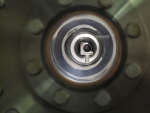 Holometer: A Microscope into Space and Time
2.09.2014
How different are space and time at very small scales? To explore the unfamiliar domain of the miniscule Planck scale -- where normally unnoticeable quantum effects might become dominant -- a newly developed instrument called the Fermilab Holometer has begun operating at the Fermi National Accelerator Laboratory (Fermilab) near Chicago, Illinois, USA.
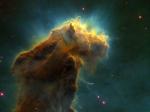 Star EGGs in the Eagle Nebula
22.10.2006
Where do stars form? One place, star forming regions known as "EGGs", are uncovered at the end of this giant pillar of gas and dust in the Eagle Nebula (M16). EGGs, short for evaporating gaseous globules, are dense regions of mostly molecular hydrogen gas that fragment and gravitationally collapse to form stars.
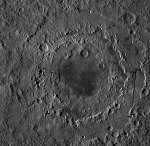 Mare Orientale
11.03.2011
Shaped like a target ring bull's-eye, the Mare Orientale is one of the most striking large scale lunar features. Located on the Moon's extreme western edge, it is unfortunately difficult to see from an earthbound perspective.
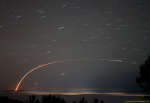 OCO 2 Night Launch
4.07.2014
In this alluring time exposure, star trails arc across the night sky above foggy Monterey Bay and the lights of Santa Cruz, California in the United States of America. Since the exposure began around...
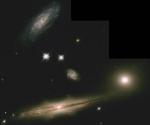 HCG 87: A Small Group of Galaxies
6.09.1999
Sometimes galaxies form groups. For example, our own Milky Way Galaxy is part of the Local Group of Galaxies. Small, compact groups, like Hickson Compact Group 87 (HCG 87) shown above, are interesting partly because they slowly self-destruct.
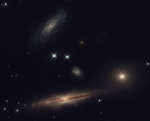 HCG 87: A Small Group of Galaxies
6.07.2010
Sometimes galaxies form groups. For example, our own Milky Way Galaxy is part of the Local Group of Galaxies. Small, compact groups, like Hickson Compact Group 87 (HCG 87) shown above, are interesting partly because they slowly self-destruct.
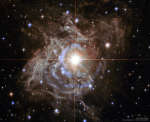 Nearby Cepheid Variable RS Pup
28.08.2018
In the center is one of the most important stars on the sky. This is partly because, by coincidence, it is surrounded by a dazzling reflection nebula. Pulsating RS Puppis, the brightest star in the image center, is some ten times more massive than our Sun and on average 15,000 times more luminous.
 SNR 0104: An Unusual Suspect
12.06.2009
SNR 0104 is a supernova remnant with an unusual shape. Found 190,000 light-years away in our neighboring galaxy the Small Magellanic Cloud, SNR 0104 is suspected of being the expanding debris cloud from a Type 1a supernova - the catastrophic thermonuclear explosion of a white dwarf star.
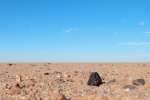 Almahata Sitta 15
27.03.2009
Small asteroid 2008 TC3 fell to Earth at dawn on October 7, 2008, tracking through the skies over the Nubian Desert in northern Sudan. That event was remarkable because it was the first time an asteroid was detected in space before crashing into planet Earth's atmosphere.
|
January February March April May |
|||||||||||||||||||||||||||||||||||||||||||||||||