
|
You entered: massive stars
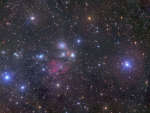 NGC 2170: Celestial Still Life
14.01.2009
Is this a painting or a photograph? In this beautiful celestial still life composed with a cosmic brush, dusty nebula NGC 2170 shines near the image center. Reflecting the light of nearby hot stars...
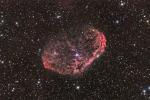 NGC 6888: The Crescent Nebula
11.11.2007
What caused the Crescent Nebula? Looking like an emerging space cocoon, the Crescent Nebula, visible in the center of the above image, was created by the brightest star in its center. A leading progenitor hypothesis has the Crescent Nebula beginning to form about 250,000 years ago.
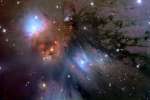 Still Life with NGC 2170
30.12.2010
In this beautiful celestial still life composed with a cosmic brush, dusty nebula NGC 2170 shines at the upper left. Reflecting the light of nearby hot stars, NGC 2170 is joined by other bluish reflection nebulae, a compact red emission region, and streamers of obscuring dust against a backdrop of stars.
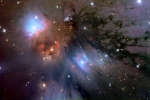 Still Life with Reflecting Dust
4.03.2017
In this beautiful celestial still life composed with a cosmic brush, dusty nebula NGC 2170 shines at the upper left. Reflecting the light of nearby hot stars, NGC 2170 is joined by other bluish reflection nebulae, a compact red emission region, and streamers of obscuring dust against a backdrop of stars.
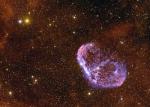 A Crescent Nebula Star Field
15.04.2003
What caused the Crescent Nebula? Looking like an emerging space cocoon, the Crescent Nebula, visible on the right, was created by the brightest star in its center. A leading progenitor hypothesis has the Crescent Nebula beginning to form about 250,000 years ago.
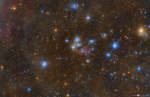 NGC 2170: Celestial Still Life
6.03.2012
Is this a painting or a photograph? In this beautiful celestial still life composed with a cosmic brush, dusty nebula NGC 2170 shines near the image center. Reflecting the light of nearby hot stars...
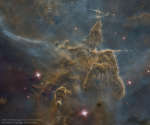 Mystic Mountain Dust Pillars
15.04.2015
It's stars versus dust in the Carina Nebula and the stars are winning. More precisely, the energetic light and winds from massive newly formed stars are evaporating and dispersing the dusty stellar nurseries in which they formed.
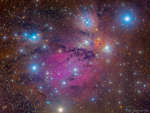 NGC 2170: Angel Nebula Still Life
26.08.2019
Is this a painting or a photograph? In this classic celestial still life composed with a cosmic brush, dusty nebula NGC 2170, also known as the Angel Nebula, shines near the image center. Reflecting...
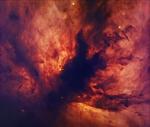 Flame Nebula Close Up
2.02.2007
Of course, the Flame Nebula is not on fire. Also known as NGC 2024, the nebula's suggestive reddish color is due to the glow of hydrogen atoms at the edge of the giant Orion molecular cloud complex some 1,500 light-years away.
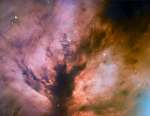 Flame Nebula Close Up
26.11.2010
Of course, the Flame Nebula is not on fire. Also known as NGC 2024, the nebula's suggestive reddish color is due to the glow of hydrogen atoms at the edge of the giant Orion molecular cloud complex some 1,500 light-years away.
|
January February March April May |
|||||||||||||||||||||||||||||||||||||||||||||||||