
|
You entered: ice
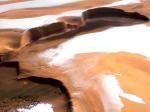 Steep Cliffs on Mars
15.03.2005
Vertical cliffs of nearly two kilometers occur near the North Pole of Mars. Also visible in the above image of the Martian North Polar Cap are red areas of rock and sand, white areas of ice, and dark areas of unknown composition but hypothesized to be volcanic ash.
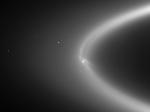 Enceladus Creates Saturns E Ring
27.03.2007
The active moon Enceladus appears to be making Saturn's E ring. An amazing picture showing the moon at work was taken late last year by the Saturn-orbiting Cassini spacecraft and is shown above. Enceladus is the bright point near the center, right near the center of Saturn's E ring.
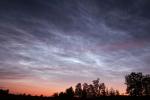 Noctilucent Clouds Over Sweden
28.10.2007
Sometimes it's night on the ground but day in the air. As the Earth rotates to eclipse the Sun, sunset rises up from the ground. Therefore, at sunset on the ground, sunlight still shines on clouds above.
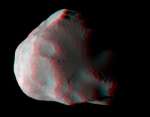 Stereo Helene
23.06.2011
Get out your red/blue glasses and float next to Helene, small, icy moon of Saturn. Appropriately named, Helene is one of four known Trojan moons, so called because it orbits at a Lagrange point. A Lagrange point is a gravitationally stable position near two massive bodies, in this case Saturn and larger moon Dione.
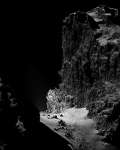 The Cliffs of Comet Churyumov Gerasimenko
22.12.2014
These high cliffs occur on the surface of a comet. They were discovered to be part of the dark nucleus of Comet ChuryumovGerasimenko (CG) by Rosetta, a robotic spacecraft launched by ESA which began orbiting the comet in early August. The ragged cliffs, as featured here, were imaged by Rosetta about two weeks ago.
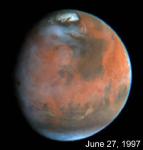 Mars: A Journey's End
3.07.1997
Mars Pathfinder is nearing the end of its 7 month journey. The robot spacecraft is scheduled to use parachutes, rockets, and airbags to "bouncedown" on the red planet tomorrow - July 4th. This Hubble Space Telescope image of Mars was taken a few days ago to check on the weather.
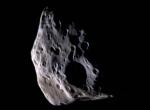 Small Moon Epimetheus
29.04.2005
Small saturnian moon Epimetheus (ep-ee-MEE-thee-us) is at most 116 kilometers across. Its cratered surface and irregular shape are highlighted by dramatic shadows in this composite close-up image from the Cassini spacecraft. However, orbiting 91,000 kilometers above Saturn's cloud tops, Epimetheus is not alone.
 Iapetus in Black and White
14.09.2007
Iapetus, Saturn's third largest moon, is a candidate for the strangest moon of Saturn. Tidally locked in its orbit around the ringed gas giant, Iapetus is sometimes called the yin-yang moon because...
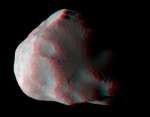 Stereo Helene
5.01.2013
Get out your red/blue glasses and float next to Helene, small, icy moon of Saturn. Appropriately named, Helene is one of four known Trojan moons, so called because it orbits at a Lagrange point. A Lagrange point is a gravitationally stable position near two massive bodies, in this case Saturn and larger moon Dione.
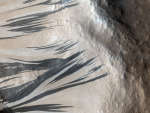 Slope Streaks in Acheron Fossae on Mars
1.03.2010
What creates these picturesque dark streaks on Mars? No one knows for sure. A leading hypothesis is that streaks like these are caused by fine grained sand sliding down the banks of troughs and craters. Pictured above, dark sand appears to have flowed hundreds of meters down the slopes of Acheron Fossae.
|
January February March April May |
|||||||||||||||||||||||||||||||||||||||||||||||||