
|
You entered: Earth's atmosphere
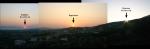 Sunrise by Season
20.12.2005
Does the Sun always rise in the same direction? No. As the seasons change, the direction toward the rising Sun will change, too. The Sun will always rise and set furthest to the south during the day of Winter Solstice, and furthest to the north during Summer Solstice.
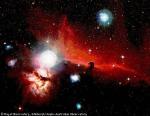 Orion's Horsehead Nebula
25.10.1997
The Horsehead Nebula is one of the most famous nebulae on the sky. It is visible as the black indentation to the red emission nebula seen just to the right of center of the above photograph. The bright star near the center is located in the belt of the familiar constellation of Orion.
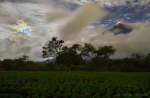 A Horizon with Blue and Red
4.12.2017
What's happening on the horizon? The horizon itself, past a spinach field in Guatemala, shows not only trees but a large volcano: the VolcАn de Fuego (Volcano of Fire). The red glow at the top of the volcano is hot lava.
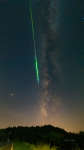 A Perseid Meteor and the Milky Way
2.08.2021
It was bright and green and flashed as it moved quickly along the Milky Way. It left a trail that took 30 minutes to dissipate. Given the day, August 12, and the direction, away...
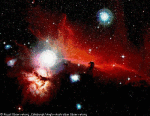 Orion's Horsehead Nebula
2.01.1999
The Horsehead Nebula is one of the most famous nebulae on the sky. It is visible as the black indentation to the red emission nebula seen just to the right of center of the above photograph. The bright star near the center is located in the belt of the familiar constellation of Orion.
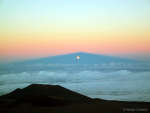 Moonrise Through Mauna Keas Shadow
2.05.2015
How can the Moon rise through a mountain? It cannot -- what was photographed here is a moonrise through the shadow of a large volcano. The volcano is Mauna Kea, Hawai'i, USA, a frequent spot for spectacular photographs since it is arguably the premier observing location on planet Earth.
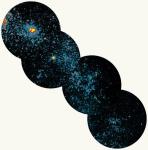 The UV SMC from UIT
23.03.2001
Translated from the "acronese" the title reads - The UltraViolet Small Magellanic Cloud from the Ultraviolet Imaging Telescope. FYI, the four ultraviolet images used in this mosaic of the nearby irregular galaxy known...
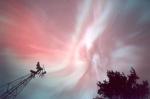 Red Auroral Corona
14.01.2002
Few auroras show this level of detail. This unusual display of an auroral corona occurred on Earth three days after an unusual solar event -- the fifth most powerful explosion yet recorded on the Sun. An X14-class solar flare on April 15 sent a tremendous Coronal Mass Ejection (CME) into the Solar System.
 Window Seat over Hudson Bay
21.09.2018
On the August 18 night flight from San Francisco to Zurich, a window seat offered this tantalizing view when curtains of light draped a colorful glow across the sky over Hudson Bay. Constructed...
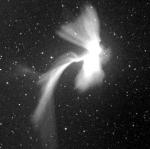 A Leonid Meteor Explodes
22.11.1998
Click on the above image and watch a Leonid meteor explode. The tremendous heat generated by the collision of a small sand-bit moving at 70 kilometers/second with the Earth's upper atmosphere causes the rock-fragment to heat up, glow brightly, and disintegrate.
|
January February |
|||||||||||||||||||||||||||||||||||||||||||||||||